
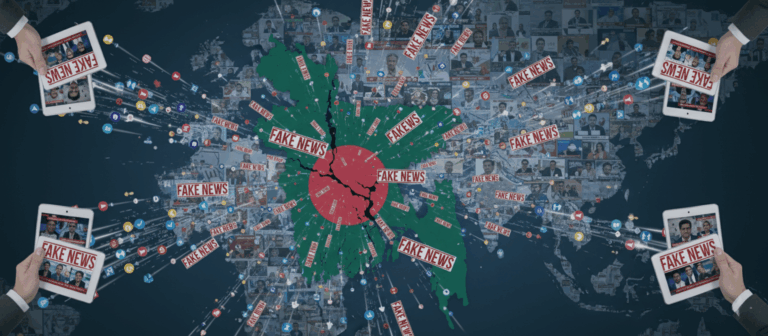
Over the past years the media environment in South Asia has seen individual concern regarding the trustworthiness of news reporting with regards to cross border stories. A good example of this move is the spread of fake or misleading news of the adjacent nation of Bangladesh in Indian newspapers. Claims about Bangladesh circulated and claimed by dozens of Indian outlets and later disproved as false or misrepresented were evidence collected by independent fact-checking organisations.
The Bangladeshi fact-checking organization Rumor Scanner published a report in December 2024 identifying 49 Indian media houses to have published other 13 false news concerning Bangladesh between 12 August and 5 December 2024. In a follow up analysis, the figure was later increased reporting that in 2024 alone, there would be at least 72 Indian media houses that have published 137 outright false stories on 32 different issues regarding Bangladesh. The misinformation items were reported to have an average of a false report in every 2.5 days according to Rumor Scanner .
The untruths spread were of all kinds, alleged communal violence in Bangladesh, forged letters by former political leaders, overstated news of bans placed on Indian television channels in Bangladesh, and supposed arms-trafficking through Bangladeshi territory . As an illustration, an item that was debunked was a letter that falsely claimed that former Prime Minister Sheikh Hasina had blamed the United States of ousting her. In a different instance a video of a Muslim man was established to be fake portraying a Hindu man in Bangladesh whose son had been searched due to being a Muslim.
The fake news drive did not consist of a select few marginal websites or social-media profiles. It included according to the investigations mainstream Indian outlets, satellite TV, and giant social-media presence. Such as Bengali-language satellite station Republic Bangla was ranked top among Indian sources with highest number of misinformation items identified with 10 cases found in a greater number of cases (137 cases) of misinformation . The other key media houses cited are the Hindustan Times, Zee News, Aaj tak and the Indian Express. In the social-media aspect, Rumor Scanner had discovered that in India, it is where about 72% of the accounts that shared misinformation about anti-Bangladesh were located .
Mechanisms
- Relaying unverified claims as breaking news without sufficient fact-checking.
- Using sensationalist headlines or visuals to grab attention.
- Cross-posting content on social-media platforms (e.g., X) and amplifying it via re-tweets and shares, sometimes by bots or coordinated accounts.
- Republishing items from one outlet into others, causing echo-chambers of misinformation. For example, one report found several Indian outlets published the same false story over multiple days .
Motives and Context
Why do all these Indian media sources get involved in releasing fake or distorted information of Bangladesh? The inspirations are complex and connected with political, strategic, audience-oriented and commercial.
Political/geopolitical motives: The time of the day matters. Most of the fake news seems to have heated up after the Awami League government in Bangladesh fell on 5 August 2024 and an interim government under the leadership of Muhammad Yunus assumed control. The analysis by Rumor Scanner connects the increase of the reports to this political transition in Bangladesh. Stories that emphasize societal unrest or persecution of the minority might in this case provide exterior accounts of how Bangladesh is doing, why it treats its minorities well and how it will be able to fit in regional politics .
Commercial and audience incentives: Sensational stories, where it is about religion, violence, or diplomatic disputes, are more likely to receive more viewership, clicks and interactions on social media. In competitive media markets, the pressure on spreading the news upwards, exclusives and viral headlines can provoke outlets to present the news before it has been properly verified .
National‐narrative and identity formation: To some end, the reports which address contributors to Bangladesh have projected the Hindu minorities as at risk implicitly appeals to the anxieties of Indian backgrounds toward Hindu groups in foreign lands and as such exploits a domestic identity politics discourse. Indian media, by way of example, was criticized by Yunus who also made the statement that fake news became the specialty of India .
Impact and Consequences
There are various consequences of the spread of fake news on Indian media against Bangladesh.
On Bangladesh–India relations: False narratives, particularly that communal violence and suppression of minorities or anti-Indian prejudice is practiced on the Bangladesh side, can provoke the diplomatic tensions, suspicion, and inability to collaborate on the bilateral issues, particularly, border control, trade, and security. A Bangladeshi government adviser in an example case has said that the threatening Indian propaganda that was perpetrated by the media was disproven. Fake claims propagation therefore weakens the goodwill in bilateral relation and causes in- weaving of media coverage in the wider regional geopolitics .
On minority communities and social cohesion: The majority of the fake news objects claim being the attacks of Hindu communities in Bangladesh. Regardless of the reality of the events that happened, whether inflated or completely argued out, such claims may lead to anxiety among the minority groups, personnel suspicion in the community, and failure in the outsider to see things as they are . This can be, in its turn, one of the contributes towards radicalizing discourses in Bangladesh as well as in the diaspora communities .
On media credibility and public trust: Through the release of fake news by mainstream media, the trust that people have in journalism is undermined. To the citizens of Bangladesh, watching neighboring media publish falsified accounts of their own affairs can result in frustration, and insurrection; to Indian viewers a cynical attitude towards what they deem to be sensationalism or bias . The greater victim is the news ecosystem integrity.
On domestic politics: Misinformation can impact the discussion of the general public, the electoral discourse and the party politics in Bangladesh and the relations of India with it. False narratives might crop whole narratives of events (e.g. protests, transitions of governments or group events) in a distorted manner and, in the end, can influence the policy reaction to a story or general opinion .
Case Studies
Some particular examples shed light on the way the process went on.
A refuted account was that of a supposed letter by Sheikh Hasina following his resignation which purported that he blamed the United States. The letter turned out to be fake in the opinion of fact-checkers. Another claim involved, which states that Bangladesh had lifted ban on militant groups – also unsubstantiated. Mis-characterization was done when a video of a Muslim man purportedly depicting a Hindu in Bangladesh being searched because he was a Muslim These are just instances of a trend in which a sensational headline can be made, followed by quick reiterations by various media houses and then the news can be disproved. Users of the Reddit platform in Bangladesh commented:
The subject of the counterfeit reports spans between assaults of minorities to Chief Adviser Muhammad Yunus to the overthrown prime minister Sheikh Hasina.
These user-observations serve to support the fact that the pattern of distortion is known publicly.
Why Verification Failed
There are some systemic reasons as to why such fake news items have been able to go viral before they are corrected.
Speed over accuracy: Within the 24/7 news cycle there is the pressure to get stories out fast, and in some cases reporting verifications are secondary to headline writing. A claim with emotion (e.g. communal violence) or that fits an existing narrative will receive quick amplification before fact-checkers have time to react.
Cross-border journalism challenges: Reporting on a fellow nation would inevitably demand linguistic, cultural and institutional knowledge. Crossover news of Bangladesh needs to be made available, local contact, understanding of backdrop and accuracy in translation; otherwise, it turns into dropping surrogacy or presumption .
Social-media amplification: Although a fake statement appears on social media, it can be featured easily in the news outlets that need to write about a trending topic, and it will also be driven by algorithmic amplifications. Based on results revealed by Rumor Scanner, the social-media accounts spreading the anti-Bangladesh fake news were largely Indian.
Lack of media accountability: In instances where there has been publication of a false report, on which they have not made efforts to retract, correct or clarify them, the damage remains the same. Fact-checking organisations can release refutations, and the original shocking statement can still be more noticeable.
Broader Implications for Journalism and Democracy:
The example of the South Asian Indian media coverage of Bangladesh is not only important to South Asia. It touches upon the common vital problems of journalism in a digital age, whether to prioritize speed over accuracy, the role of social-media forces, whether to frame issues in nationalistic or sensational terms, and whether to frame across borders (Roy and DeRoche, 2025).
Media as gatekeepers: The media institutions were traditionally charged with a responsibility of verification and service to the community. However, the erosion of the gatekeeper, the emergence of the social-media-driven storytelling and the heightened commercial rivalry imply that media institutions have existential reasons to focus on the click ability of what they say over its content.
Implication on regional collaboration: Mis-reporting of a neighboring country, will weaken regional trust and cooperation within a field such as South Asia whose historical links, border and cultural affiliations, are intricate. Mis-coverage by media often fuels the views, misunderstands actions, and is in itself a source of diplomatic assignations.
Citizen literacy and fact-checker: In this context, the media users will need to be more critical, and the organisations that provide fact-checking be more active. Credible checking, transparency of sources and corrections are essential as a way of building back trust. The example of such organisations as Rumor Scanner demonstrates the value of the independent review .
Moral responsibility in cross-border coverage: When a journalist is reporting on other countries, particularly those with intricate socio-political life, the following question should be posed by the journalist and his or her editor, Are the sources good? Have we put the story into context? Is this a fabrication or is this cherry-picking? Are we spreading stereotypes or extreme politics? The case of Bangladesh indicates that usually these questions were not adequately addressed .
The facts are quite clear that many Indian media houses printed wrong or misleading news about Bangladesh in 2024 and most of the assertions were based on sensationalist, communal or geopolitical narratives more than a factual one. These propagations were facilitated by the mechanisms of spread, as the narratives were exposed to a very great number of people via the processes of social-media amplification, cross-posting across outlets, or through the processes of rapid news cycles, all before proper verification. The implication in the way of Bangladesh-India relations, minority communities and the credibility of the media are enormous.
This case serves as a reminder that journalism, especially in a globalized regional setting, has a lot of responsibilities. News and propaganda can be mixed up at times with the convergence of national interests, population pressures, and business interests. To ensure that media play the roles of democracy and serving the interest of the people, strict verification, responsibility of erroneous reportages, open correction and sense of fixation on context should be obligatory. Lacking that, the trust levels are damaged, the people are not educated properly and bilateral relations are ruined.
With the changing media environment both consumers and producers of the content need to be very watchful, producers need to maintain the standard of accuracy, context and fairness and consumers need to scrutinize and verify the sources and fall into the trap of fallacious stories which do not match the facts on the ground. The lesson in the case of Bangladesh and Indian media is obvious: unmonitored stories may confuse states, betray trust and ruin communities.
References
Muzykant, V., Hossain, B., Muqsith, M. and Fatima, M., 2022. Media literacy and fake news: bangladesh perspective. Jurnal Cita Hukum-Indonesian Law Journal, 10(2).
Karim, F., 2021. Fake news on social media-who consume it and why: Bangladesh perspective. Communication and Media in Asia Pacific (CMAP), 4(1), pp.11-22.
Roy, M. and DeRoche, M., 2025. Mapping Misinformation: A Network Analysis of Fake News in India and Bangladesh on X (Twitter). Available at SSRN 5003668.
Afrin, S., 2022. Fake News in Social Media: Exploring the Impacts and Regulating Laws on Spreading Out Fake News (Doctoral dissertation, East West University).
Kanozia, R. and Arya, R., 2021. “Fake news”, religion, and COVID-19 vaccine hesitancy in India, Pakistan, and Bangladesh. Media Asia, 48(4), pp.313-321.
Shirina, S.U. and Prodhan, M.T.R., 2020. Spreading Fake News in the Virtual Realm in Bangladesh: Assessment of Impact. Global Journal of HUMAN-SOCIAL SCIENCE: A Arts & Humanities-Psychology, 20, p.17.
Al-Zaman, M.S., 2021. Social media fake news in india. Asian Journal for Public Opinion Research, 9(1), pp.25-47.
Haque, M.M., Yousuf, M., Alam, A.S., Saha, P., Ahmed, S.I. and Hassan, N., 2020. Combating misinformation in Bangladesh: Roles and responsibilities as perceived by journalists, fact-checkers, and users. Proceedings of the ACM on Human-Computer Interaction, 4(CSCW2), pp.1-32.
Islam, F., Alam, M.M., Hossain, S.S., Motaleb, A., Yeasmin, S., Hasan, M. and Rahman, R.M., 2020, August. Bengali fake news detection. In 2020 IEEE 10th International Conference on Intelligent Systems (IS) (pp. 281-287). IEEE.
Ahmed, M., 2025. Devils Journalism: Global, South Asia and Special Focus on Bangladesh.
Islam, M.A., Hossain, M.S., Prodhan, M.T.R. and Siddique, M.A.B., 2023. Spreading Fake Content via Social Media among Tertiary Level Students in Rangpur, Bangladesh. Journal of Media Culture and Communication.
Alkawaz, M.H. and Khan, S.A., 2020, February. Use of fake news and social media by main stream news channels of india. In 2020 16th IEEE International Colloquium on Signal Processing & Its Applications (CSPA) (pp. 93-97). IEEE.
Mondal, P.K., Khan, S.S., Rana, M.M., Ramit, S.S., Sattar, A. and Rahman, M.S., 2024, June. Breaking the Fake News Barrier: Deep Learning Approaches in Bangla Language. In 2024 15th International Conference on Computing Communication and Networking Technologies (ICCCNT) (pp. 1-6). IEEE.
Bhadra, A., 2024. From Social Media to Global Misinformation: The Role of Citizen Journalism and Photojournalism in the Spread of False News Amid the Bangladesh Crisis: A Case Analysis. International Journal for Multidisciplinary Research, 6(4).
Roy, M. and DeRoche, M., 2025. Mapping Misinformation: A Network Analysis of Fake News in India and Bangladesh on X (Twitter). Available at SSRN 5003668.
Das, N.R., Alam, M.M., Polok, A.P., Raquib, M., Al Mamun, A. and Hossen, M.J., 2024. Social media bangla fake news detection using deep and machine learning algorithms. nternational Journal of Engineering Trends and Technology, 72(5), pp.346-354.
Shukla, A.K. and Shrivastava, M., 2024. Protecting Free Speech and Curbing the Spread of Disinformation in the Age of COVID-19: Did the South Asian Nations Get the Balance Right?. In Human Rights During the COVID-19 Pandemic: The South Asian Experience (pp. 101-116). Singapore: Springer Nature Singapore.
Haque, R., Senathirajah, A.S., Qazi, S.Z., Afrin, N., Ahmed, M.N. and Khalil, M.I., 2024. Factors of information literacy preventing fake news: A case study of libraries in developing countries. International Journal of Religion, 5(7), pp.804-817.
Chowdhury, A.S., Shahariar, G.M., Aziz, A.T., Alam, S.M., Sheikh, M.A. and Belal, T.A., 2025. Tackling fake news in bengali: Unraveling the impact of summarization vs. augmentation on pre-trained language models. SN Computer Science, 6(8), pp.1-26.
Roy, U., Tahosin, M.S., Hasan, M.M., Islam, T., Imtiaz, F., Sadik, M.R., Maleh, Y., Sulaiman, R.B. and Hassan Talukder, M.S., 2024, April. Enhancing Bangla fake news detection using bidirectional gated recurrent units and deep learning techniques. In Proceedings of the 7th International Conference on Networking, Intelligent Systems and Security (pp. 1-10).
Sadik, M.R., Rana, M.M., Akter, L., Islam, R., Rahman, M.H. and Rahman, M.M., 2024, February. Supervised Machine Learning Approaches to Identify the False and True News from Social Media Data. In 2024 International Conference on Social and Sustainable Innovations in Technology and Engineering (SASI-ITE) (pp. 15-20). IEEE.