
Ayaz Rahman is the South Asia Media Chronicler of BDMM
At least five Indian media outlets, India Today, Kolkata 24×7, Anandabazar Patrika, News18, and Hindustan Times Bangla published reports between 1 and 3 September 2026, concerning Bangladesh’s objections to India’s proposed Settlement Nodal Agency (SNA) charge for cross-border electricity transactions and Bangladesh’s decision to purchase electricity generated through a Chinese waste-to-energy project at a substantially higher headline tariff.
Although all five reports address substantially the same underlying development, they differ considerably in their framing intensity, source diversity, quotation practices, evidence strength, emotional language, descriptor choices, and source transparency. The inclusion of Hindustan Times Bangla expands the corpus by adding another Bengali-language Indian media outlet that adopts a strong India-China economic comparison while providing some contextual information concerning Bangladesh’s energy crisis and the environmental rationale of the Chinese project.
The central numerical contrast across the five reports is between approximately Tk 11 per unit, the average price Bangladesh paid for electricity from Indian suppliers in FY2025–26, and Tk 25 per unit, the proposed tariff associated with electricity generated through the Chinese-backed Aminbazar waste-to-energy project. The reports also discuss Bangladesh’s objection to an Indian SNA charge initially proposed at Rs 0.01 per unit and subsequently reduced to Rs 0.005 per unit.
A crucial methodological issue is that the SNA charge and the Chinese electricity tariff are not equivalent categories of cost. The SNA charge concerns cross-border transaction and grid-related services, whereas the Tk 25 figure refers to the proposed electricity tariff from a waste-to-energy project. News18 and India Today make this distinction particularly clearly, while the other reports vary in the extent to which they qualify the comparison.
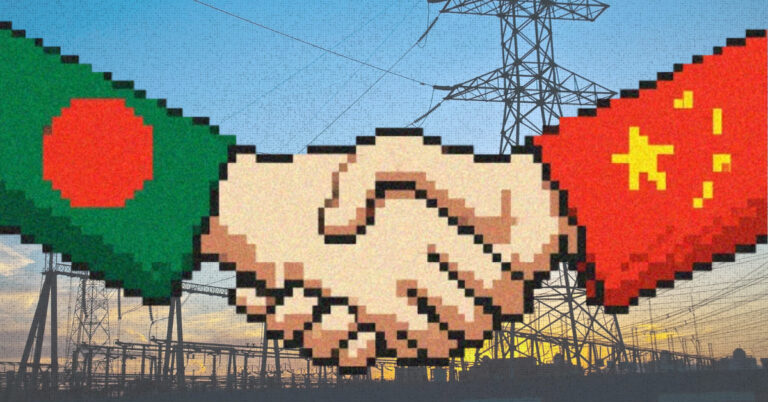
The five outlets nevertheless share a common narrative structure. Bangladesh’s objection to a relatively small India-related electricity charge is juxtaposed with its willingness to purchase Chinese electricity at a substantially higher headline tariff. This produces an apparent economic contradiction, which is then connected, to varying degrees, with the broader India–Bangladesh–China geopolitical relationship.
The primary frame across the corpus is therefore an economic-energy frame: Bangladesh is portrayed as accepting a comparatively expensive Chinese electricity arrangement while objecting to an additional India-related charge.
The secondary frame is geopolitical: the electricity decision is presented as part of Bangladesh’s broader diversification of external economic and strategic relationships, particularly its growing engagement with China and its changing relationship with India.
The five reports do not construct this frame with equal intensity. India Today and News18 provide the strongest combination of evidence and contextual qualification. Anandabazar Patrika employs substantially stronger emotional and geopolitical language. Kolkata 24×7 presents the most compressed and rhetorically confrontational version of the economic contradiction. Hindustan Times Bangla occupies an intermediate position in terms of evidence but uses a strongly framed and provocative headline.
This comparative analysis evaluates the five reports through the Seven-Dimensional Codebook:
- Lead Framing Index (LFI)
- Source Diversity Index (SDI)
- Quote Distribution Balance (QDB)
- Evidence Strength Index (ESI)
- Emotional Framing Index (EFI)
- Labeling and Descriptor Bias (LDB)
- Source Transparency Index (STI)
The objective is not simply to determine whether the reports contain accurate information. Rather, the analysis examines how journalistic selection, organisation, sourcing, language, and contextualisation influence the reader’s interpretation of the India–Bangladesh–China electricity issue.
1. Article Information
| Media Outlet | Country | Publication Date | Headline | Article Type | Principal Contemporary Source | Secondary Source | Primary Frame | Secondary Frame | Central Issue |
| India Today | India | 1 September 2026 | “Bangladesh protests India’s Rs 0.01 hike, eyes 127% costlier Chinese power. Here’s why” | News/explanatory report | Bangladesh government officials; electricity-sector information | The Daily Star; New Age | Economic-energy comparison | Geopolitical/economic diversification | Bangladesh’s objection to India’s SNA charge versus proposed Chinese waste-to-energy electricity |
| Kolkata 24×7 | India | 2 September 2026 | “ভারতের ১১ টাকা ইউনিট বিদ্যুতে না তারেকের! চিনের ২৫ টাকা ইউনিটের বিদ্যুতেই ভরসা বাংলাদেশের” | News report | Electricity-sector/government information | Unnamed analysts | Economic contradiction | India–China geopolitical comparison | Bangladesh’s rejection of relatively inexpensive Indian electricity while accepting costlier Chinese electricity |
| News18 | India | 2 September 2026 | “Bangladesh Objected To India’s Rs 0.01 Power, Then Agreed To Pay China 127% More” | News/explanatory report | Bangladesh government officials; The Daily Star; New Age | India Today; regulatory information | Economic-energy contradiction | Energy diversification/geopolitical context | Bangladesh’s objection to India’s SNA charge alongside proposed higher-cost Chinese electricity |
| Hindustan Times Bangla | India | 2 September 2026 | “ভারত আধা পয়সা চার্জ করায় রাগ! দ্বিগুণেরও বেশি দামে চিনা বিদ্যুৎ কিনতে অবশ্য সমস্যা নেই বাংলাদেশের” | News report | Bangladesh government; State Minister Mir Shahe Alam | Electricity-sector figures and project information | Economic contradiction | India–Bangladesh relationship | Bangladesh’s acceptance of expensive Chinese electricity despite objection to an Indian charge |
| Anandabazar Patrika | India | 3 September 2026 | “আধ পয়সা বেশি চাইতেই অগ্নিশর্মা, ভারতকে ‘শিক্ষা’ দিতে ১২৭% বেশি খরচে চিনা বিদ্যুৎ কিনছে ‘বুদ্ধিমান’ বাংলাদেশ!” | News/photo-gallery report with strong commentary | Bangladesh government officials | Analysts/observers; diplomatic sources | Economic contradiction | India–Bangladesh geopolitical tension | Bangladesh’s alleged costly shift from Indian to Chinese electricity |
2. Lead Framing Index (LFI)
India Today – 1/2
India Today establishes its interpretation immediately through the headline:
“Bangladesh protests India’s Rs 0.01 hike, eyes 127% costlier Chinese power. Here’s why”
The headline constructs an explicit contrast between Bangladesh’s objection to the Indian charge and its prospective purchase of more expensive Chinese electricity.
The opening reinforces this by describing the situation as a “striking contradiction.”
However, the article subsequently provides important qualifications. It explains that the SNA charge and Chinese electricity tariff are not directly comparable, that the Chinese project is only 42 MW, and that the project is primarily designed to address Dhaka’s waste-management problem rather than replace India’s much larger electricity supplies.
The report therefore uses a clear interpretive frame but subsequently qualifies it.
Score: 1/2 – Moderate framing.
Kolkata 24×7 – 0/2
Kolkata 24×7 places the India-versus-China price comparison at the centre of the headline and article.
The report asks, in effect, why Bangladesh would object to a relatively small Indian electricity-related charge while accepting Chinese electricity at a much higher rate.
The article provides insufficient distinction between the SNA charge and the electricity-generation tariff.
The headline and lead therefore strongly direct the reader toward an interpretation of economic inconsistency.
Score: 0/2 – Strong framing.
News18 – 1/2
News18’s headline strongly foregrounds the same contradiction:
“Bangladesh Objected To India’s Rs 0.01 Power, Then Agreed To Pay China 127% More”
The India–China comparison is the principal organising device.
However, the article explicitly explains that the SNA charge is not itself the price of electricity and that the two charges are not directly comparable.
It also explains the waste-management rationale and limited scale of the Chinese project.
Score: 1/2 – Moderate framing.
Hindustan Times Bangla – 0/2
Hindustan Times Bangla uses a highly provocative headline:
“ভারত আধা পয়সা চার্জ করায় রাগ! দ্বিগুণেরও বেশি দামে চিনা বিদ্যুৎ কিনতে অবশ্য সমস্যা নেই বাংলাদেশের”
The headline effectively says that Bangladesh became angry over India charging “half a paisa” while having no apparent problem buying Chinese electricity at more than double the price.
This immediately constructs a narrative of inconsistency.
The opening paragraph reinforces this interpretation by stating that Bangladesh had the opportunity to obtain comparatively cheaper electricity from India but agreed to buy electricity from a Chinese company at a much higher price.
Although the article later explains the environmental and waste-management rationale of the Chinese project and acknowledges that the project is not a direct replacement for Indian electricity, these qualifications appear after the contradiction has already been established.
The lead therefore strongly privileges one interpretation.
Score: 0/2 – Strong framing.
Anandabazar Patrika – 1/2
Anandabazar uses the most explicitly rhetorical headline among the five outlets, including expressions equivalent to “teaching India a lesson” and sarcastically describing Bangladesh as “intelligent.”
The opening similarly suggests that Bangladesh is harming itself while opposing India.
Although the body contains factual information and government statements, the interpretive direction is established before those qualifications appear.
Score: 1/2 – Moderate-to-strong framing.
3. Source Diversity Index (SDI)
India Today – 1/2
India Today uses:
- Bangladesh government officials,
- State Minister Mir Shahe Alam,
- The Daily Star,
- New Age,
- electricity-sector information,
- institutional/regulatory information.
However, independent economists, Chinese project representatives, and civil-society perspectives are limited.
Score: 1/2 – Moderate source diversity.
Kolkata 24×7 – 0/2
Kolkata 24×7 relies primarily on general reporting and references to unnamed analysts.
There is little identifiable participation from independent experts, regulators, Chinese project representatives, or affected communities.
Score: 0/2 – Low source diversity.
News18 – 1/2
News18 draws on:
- Bangladesh government officials,
- The Daily Star,
- New Age,
- India Today,
- regulatory information.
The range is broader than a single-source report.
However, there remains limited independent expert analysis and no substantial Chinese project-side perspective.
Score: 1/2 – Moderate source diversity.
Hindustan Times Bangla – 0/2
Hindustan Times Bangla primarily presents:
- Bangladesh government information,
- State Minister Mir Shahe Alam,
- electricity-sector figures,
- project information.
The article does not meaningfully introduce independent energy economists, Chinese project representatives, Indian electricity authorities, civil-society actors, or alternative policy perspectives.
The government’s justification is included, but source diversity remains limited.
Score: 0/2 – Low source diversity.
Anandabazar Patrika – 1/2
Anandabazar incorporates:
- Bangladeshi officials,
- Indian officials,
- foreign-policy officials,
- analysts,
- diplomatic observers.
This provides moderate diversity, although independent economic and energy-sector perspectives remain limited.
Score: 1/2 – Moderate source diversity.
4. Quote Distribution Balance (QDB)
India Today – 1/2
India Today includes a direct quotation from State Minister Mir Shahe Alam but lacks equivalent direct quotations from independent experts, Indian electricity authorities, or Chinese project representatives.
Score: 1/2 – Partially balanced.
Kolkata 24×7 – 0/2
The report contains no meaningful distribution of direct quotations among competing perspectives.
References to unnamed analysts do not constitute meaningful quotation balance.
Score: 0/2 – Unbalanced/absent.
News18 – 1/2
News18 directly quotes Mir Shahe Alam concerning the waste-management rationale of the project.
The Bangladeshi government therefore has a direct voice, but competing perspectives are not similarly quoted.
Score: 1/2 – Partially balanced.
Hindustan Times Bangla – 0/2
Hindustan Times Bangla attributes the government’s rationale to State Minister Mir Shahe Alam but does not provide a meaningful set of direct quotations from competing or independent perspectives.
The article therefore gives considerable narrative space to the government position but does not create a balanced quotation structure.
Score: 0/2 – Unbalanced/absent.
Anandabazar Patrika – 1/2
Anandabazar provides quotations from Bangladeshi and Indian officials.
This gives it greater quotation diversity than Kolkata 24×7 or Hindustan Times Bangla.
However, independent expert voices remain limited.
Score: 1/2 – Partially balanced.
5. Evidence Strength Index (ESI)
India Today – 2/2
India Today provides extensive quantitative evidence and, importantly, explains the methodological limitations of the price comparison.
It identifies:
- approximately Tk 11 per unit,
- Tk 25 per unit,
- 42 MW,
- India’s 15.8% share of Bangladesh’s electricity purchase cost,
- approximately Tk 19,225 crore spent on Indian electricity,
- total electricity purchase costs of approximately Tk 1,21,420 crore,
- and the SNA reduction from Rs 0.01 to Rs 0.005.
It also explicitly states that the two charges are not directly comparable.
Score: 2/2 – Strong evidence.
Kolkata 24×7 – 1/2
The article provides important numerical information, particularly the Tk 11 and Tk 25 figures and 42 MW capacity.
However, it does not sufficiently distinguish the SNA charge from the electricity tariff and relies on unidentified analysts.
Score: 1/2 – Moderate evidence.
News18 – 2/2
News18 provides a particularly strong evidentiary presentation.
It gives detailed figures concerning:
- the SNA charge,
- Indian electricity prices,
- the Chinese tariff,
- project capacity,
- Indian electricity imports,
- historical electricity-import costs,
- and Bangladesh’s overall electricity expenditure.
It also explicitly explains that the SNA charge and Chinese electricity tariff are not directly comparable.
Furthermore, the report explains the wider economics of the waste-to-energy project, including waste processing, electricity generation, organic fertiliser, landfill use, environmental benefits and potential carbon credits.
Score: 2/2 – Strong evidence.
Hindustan Times Bangla – 1/2
Hindustan Times Bangla provides several specific and useful figures:
- approximately Tk 11 per unit for Indian electricity,
- Tk 25 per unit for the Chinese project,
- approximately 127% higher cost,
- 42 MW project capacity,
- 9–10 hours of load shedding in some areas,
- gas demand exceeding 100 crore cubic feet per day versus approximately 70 crore cubic feet supplied,
- approximately 2,656 MW of Indian electricity arrangements,
- India’s approximately 15.8% share of Bangladesh’s electricity imports/purchase,
- and the expected 2028 grid connection.
The article also provides the government’s explanation that the project addresses waste management, electricity generation, organic fertiliser and potential carbon-credit benefits.
However, the article does not provide the same level of methodological qualification found in India Today and News18 concerning the distinction between the SNA charge and the Chinese electricity tariff.
It also does not offer substantial independent verification or expert economic assessment.
Score: 1/2 – Moderate evidence.
Anandabazar Patrika – 1/2
Anandabazar provides considerable quantitative evidence and explains the functions of the SNA charge.
However, some broader political interpretations are less directly substantiated by the economic evidence.
Score: 1/2 – Moderate evidence.
6. Emotional Framing Index (EFI)
India Today – 1/2
Uses phrases such as:
- “striking contradiction”
- “costlier Chinese power”
- “politically sensitive moment”
The language is evaluative but relatively restrained.
Score: 1/2 – Moderate emotional framing.
Kolkata 24×7 – 0/2
The report repeatedly emphasises the contradiction between Indian and Chinese electricity prices and employs provocative headline language.
Score: 0/2 – High emotional framing.
News18 – 1/2
The headline is provocative, but the body is predominantly explanatory.
The article uses contradiction-oriented language but does not employ the sarcasm characteristic of Anandabazar.
Score: 1/2 – Moderate emotional framing.
Hindustan Times Bangla – 0/2
The headline is overtly rhetorical:
“ভারত আধা পয়সা চার্জ করায় রাগ!”
The formulation implies emotional overreaction by Bangladesh.
The phrase suggesting that Bangladesh has no problem paying more than twice as much to China further establishes an accusatory contrast.
The body also repeatedly returns to this contradiction.
Score: 0/2 – High emotional framing.
Anandabazar Patrika – 0/2
Anandabazar remains the most overtly emotional report, using sarcasm and language suggesting that Bangladesh is deliberately attempting to “teach India a lesson.”
Score: 0/2 – High emotional framing.
7. Labeling and Descriptor Bias (LDB)
India Today – 1/2
The expressions “costlier Chinese power” and “striking contradiction” create moderate evaluative framing, but the article subsequently provides substantial qualification.
Score: 1/2 – Moderate descriptor bias.
Kolkata 24×7 – 0/2
The repeated India-versus-China price contrast produces a strongly asymmetrical interpretation.
Score: 0/2 – High descriptor bias.
News18 – 1/2
The headline and repeated contrast produce moderate descriptor bias.
However, the report also explains the Chinese project’s environmental rationale and the non-equivalence of the two charges.
Score: 1/2 – Moderate descriptor bias.
Hindustan Times Bangla – 0/2
The headline labels Bangladesh’s response as anger over an extremely small charge and contrasts it with willingness to pay a much higher Chinese price.
This creates a strong asymmetry:
India = comparatively inexpensive and unfairly treated
versus
China = substantially more expensive but accepted by Bangladesh.
The article’s language therefore directs the reader toward an interpretation of inconsistency.
Score: 0/2 – High descriptor bias.
Anandabazar Patrika – 0/2
The sarcastic description of Bangladesh as “intelligent” and the suggestion that it is attempting to “teach India a lesson” constitute strong descriptor bias.
Score: 0/2 – High descriptor bias.
8. Source Transparency Index (STI)
India Today – 2/2
The article clearly identifies:
- The Daily Star,
- New Age,
- Mir Shahe Alam,
- relevant institutional information.
Score: 2/2 – High transparency.
Kolkata 24×7 – 0/2
The report relies on unidentified analysts and provides limited source provenance for important claims.
Score: 0/2 – Low transparency.
News18 – 2/2
News18 clearly identifies:
- India Today,
- The Daily Star,
- New Age,
- Mir Shahe Alam,
- CERC-related information.
Its major factual claims are relatively traceable.
Score: 2/2 – High transparency.
Hindustan Times Bangla – 1/2
Hindustan Times Bangla clearly identifies the government as the source of the project rationale and identifies State Minister Mir Shahe Alam.
The article also attributes specific information to the Bangladesh government and provides the author’s identity.
However, many of the quantitative and contextual claims are presented without detailed source attribution, and there are no clearly identified independent expert sources.
The article therefore has identifiable institutional attribution but incomplete provenance for some major claims.
Score: 1/2 – Moderate transparency.
Anandabazar Patrika – 1/2
The report identifies several officials and direct sources but also relies on partially vague references to analysts and observers.
Score: 1/2 – Moderate transparency.
9. Final Codebook Score
| Dimension | India Today | News18 | Anandabazar Patrika | Hindustan Times Bangla | Kolkata 24×7 |
| Lead Framing Index (LFI) | 1/2 | 1/2 | 1/2 | 0/2 | 0/2 |
| Source Diversity Index (SDI) | 1/2 | 1/2 | 1/2 | 0/2 | 0/2 |
| Quote Distribution Balance (QDB) | 1/2 | 1/2 | 1/2 | 0/2 | 0/2 |
| Evidence Strength Index (ESI) | 2/2 | 2/2 | 1/2 | 1/2 | 1/2 |
| Emotional Framing Index (EFI) | 1/2 | 1/2 | 0/2 | 0/2 | 0/2 |
| Labeling & Descriptor Bias (LDB) | 1/2 | 1/2 | 0/2 | 0/2 | 0/2 |
| Source Transparency Index (STI) | 2/2 | 2/2 | 1/2 | 1/2 | 0/2 |
| Total | 9/14 | 9/14 | 5/14 | 2/14 | 1/14 |
| Percentage | 64.29% | 64.29% | 35.71% | 14.29% | 7.14% |
10. Classification
| Rank | Media Outlet | Score | Percentage | Classification |
| 1= | India Today | 9/14 | 64.29% | Moderately-to-Strongly Framed / Evidence-Supported Comparative Energy Report |
| 1= | News18 | 9/14 | 64.29% | Moderately-to-Strongly Framed / Evidence-Supported Comparative Energy Report |
| 3 | Anandabazar Patrika | 5/14 | 35.71% | Strongly Framed / Emotionally Charged India-Centric Energy-Geopolitical Report |
| 4 | Hindustan Times Bangla | 2/14 | 14.29% | Highly Framed / Low-Diversity India–China Comparative Energy Report |
| 5 | Kolkata 24×7 | 1/14 | 7.14% | Highly Framed / Low-Transparency India–China Comparative Energy Report |
The addition of Hindustan Times Bangla is analytically significant because it falls between Anandabazar Patrika and Kolkata 24×7 in the overall ranking, but it differs from both by providing a substantial amount of factual context despite its strong lead framing.
11. Dominant Frame
The dominant frame across all five Indian media outlets can be represented as:
Bangladesh objects to a relatively small India-related electricity charge → Bangladesh prepares to purchase Chinese electricity at a much higher headline tariff → apparent economic contradiction → India’s established electricity relationship is contrasted with China’s emerging role.
The frame is remarkably consistent.
However, its intensity differs:
India Today
Contradiction + qualification
The article foregrounds the contradiction but subsequently explains why the comparison should not be interpreted literally.
News18
Contradiction + qualification + project rationale
News18 similarly foregrounds the contradiction but provides considerable evidence explaining the environmental and economic rationale of the Chinese project.
Hindustan Times Bangla
Contradiction + energy crisis
The article strongly emphasises the apparent inconsistency but also places it against Bangladesh’s severe electricity and gas shortages.
Anandabazar Patrika
Contradiction + political distancing from India
The report moves further into geopolitical interpretation and uses highly evaluative language.
Kolkata 24×7
Contradiction as central narrative
The article presents the India–China price difference most directly and with the least methodological qualification.
12. Comparative Assessment
12.1 India Today and News18: Strongest Evidence Base
The addition of News18 reinforces the conclusion that India Today and News18 represent the strongest evidence-supported reports in the corpus.
Both:
- identify multiple sources,
- provide detailed numerical information,
- explain the 42 MW capacity,
- discuss India’s larger electricity supplies,
- explain the waste-management rationale,
- and explicitly recognise that the SNA charge and Chinese electricity tariff are not directly comparable.
Their identical score of 9/14 is therefore methodologically justified.
12.2 Hindustan Times Bangla: Strong Frame but Moderate Evidence
Hindustan Times Bangla presents a particularly strong contradiction frame.
Its headline immediately juxtaposes:
India: half-paisa-level charge
with
China: more than double the electricity price.
The article then provides considerable contextual information concerning Bangladesh’s electricity crisis, gas shortages, the 42 MW capacity of the Chinese project, India’s approximately 2,656 MW electricity arrangements, and the government’s waste-management rationale.
This prevents the article from being classified as evidentially weak.
However, its source diversity is limited. The report primarily relies on government information and does not provide substantial independent expert or competing perspectives.
The key methodological distinction is therefore:
Hindustan Times Bangla contains more evidence than its low overall score might initially suggest, but that evidence is organised within a strongly framed and relatively narrow source structure.
12.3 Anandabazar Patrika: Strong Geopolitical Interpretation
Anandabazar goes beyond the electricity question and connects the development to broader India–Bangladesh geopolitical tensions.
Its framing is therefore particularly relevant for a study of geopolitical media narratives.
However, its use of sarcasm and evaluative descriptors substantially reduces its scores on emotional framing and descriptor neutrality.
12.4 Kolkata 24×7: Strongest Simplification
Kolkata 24×7 reduces the issue primarily to an India-versus-China price comparison.
Its limited source transparency and absence of meaningful direct quotations further weaken its methodological standing.
It therefore receives the lowest score.
13. Methodological Significance
13.1 SNA Charge and Electricity Tariff Are Not Equivalent
This remains the most important methodological issue in the corpus.
The SNA charge is associated with the settlement and operation of cross-border electricity transactions.
The Tk 25 Chinese figure represents the proposed electricity tariff from a waste-to-energy project.
Therefore:
SNA charge ≠ electricity-generation tariff.
India Today and News18 explicitly acknowledge this distinction.
Hindustan Times Bangla provides the figures but does not explain the distinction with the same degree of clarity.
This matters because a reader could otherwise interpret the coverage as showing that Bangladesh rejected a cheap Indian electricity price while accepting a more expensive Chinese electricity price.
That interpretation is incomplete.
The more precise formulation is:
Bangladesh objected to an additional Indian cross-border transaction-related charge while separately agreeing to a proposed higher electricity tariff associated with a Chinese waste-to-energy project.
14. Waste-to-Energy Context
The Chinese project cannot be evaluated exclusively as an electricity procurement arrangement.
Its stated objectives include:
- processing urban waste,
- generating electricity,
- producing organic fertiliser,
- addressing landfill problems,
- providing environmental benefits,
- and potentially generating carbon-credit revenues.
Hindustan Times Bangla explicitly includes the Bangladeshi government’s argument that the higher cost may be partially offset by environmental benefits and carbon credits.
This means that the appropriate economic question is not simply:
“Why would Bangladesh pay Tk 25 for electricity?”
A fuller question is:
“Does the combined waste-management, environmental and electricity-generation value justify the Tk 25 tariff?”
The five articles do not provide sufficient independent economic analysis to answer that question conclusively.
15. Scale and Strategic Significance
The Chinese project is planned at approximately 42 MW.
Bangladesh, meanwhile, has electricity-import arrangements from India involving approximately 2,656 MW.
The Chinese project therefore cannot reasonably be interpreted as a direct replacement for India’s electricity relationship with Bangladesh.
The evidence is more consistent with:
incremental diversification
rather than:
complete displacement of India by China.
Hindustan Times Bangla explicitly recognises that the Chinese project is not a direct alternative to Indian electricity and contrasts its 42 MW capacity with the much larger Indian supply arrangements.
This qualification is important because it limits the extent to which the electricity decision can be interpreted as evidence of a complete geopolitical realignment.
16. Geopolitical Framing
The five reports demonstrate how an energy-policy story can be transformed into a broader geopolitical narrative.
The common progression is:
Electricity price → India–Bangladesh disagreement → Chinese electricity purchase → India–China comparison → broader geopolitical interpretation.
This progression is strongest in Anandabazar Patrika.
It is moderate in India Today and News18.
It is present in Hindustan Times Bangla through its explicit connection of the issue to India–Bangladesh relations.
It is less developed but still implicit in Kolkata 24×7.
The important methodological distinction is:
A report framing an economic decision as geopolitical does not prove that the underlying policy decision was caused by geopolitical motives.
The media framing is observable.
The causal motivation requires independent evidence.
17. Indian Strategic and Commercial Interest
Across the five reports, India is generally represented as:
- an established electricity supplier,
- a relatively lower-cost source in the comparison,
- a major electricity partner,
- and an important component of Bangladesh’s energy-security structure.
China is generally represented as:
- an emerging infrastructure partner,
- a provider of a waste-to-energy project,
- a higher-cost electricity supplier,
- and potentially part of Bangladesh’s diversification strategy.
This framing may be compatible with Indian strategic and commercial interests, particularly because it emphasises the economic advantages and strategic importance of the India–Bangladesh electricity relationship.
However, the articles themselves do not establish direct editorial influence by Indian energy companies, government agencies, or other commercial actors.
Therefore, the academically defensible formulation is:
The coverage may indirectly reinforce an India-favourable economic and geopolitical narrative, but the evidence does not establish direct corporate or governmental influence over editorial decision-making.
18. Emotional and Linguistic Comparison
The five outlets demonstrate a clear hierarchy.
Moderate emotional framing
India Today – EFI 1/2
Uses contradiction language but provides substantial qualification.
News18 – EFI 1/2
Uses a provocative headline but maintains an explanatory tone.
High emotional framing
Hindustan Times Bangla – EFI 0/2
The headline portrays Bangladesh’s reaction to India’s charge as anger and emphasises the apparent willingness to pay China substantially more.
Anandabazar Patrika – EFI 0/2
Uses sarcasm and explicit political language.
Kolkata 24×7 – EFI 0/2
Uses a provocative contradiction-based narrative.
This demonstrates that the same underlying numerical information can be framed at substantially different emotional intensities.
19. Source and Evidence Comparison
The five reports can be divided into three broad groups.
Group 1: Strong evidence and transparency
India Today
News18
These two reports combine:
- multiple sources,
- strong numerical evidence,
- identifiable attribution,
- contextual qualification,
- and explicit recognition of the limitations of the price comparison.
Group 2: Moderate evidence with stronger rhetorical framing
Anandabazar Patrika
Hindustan Times Bangla
Both provide substantial factual material but rely more heavily on official information and use stronger interpretive language.
Group 3: Highly compressed and weakly transparent
Kolkata 24×7
The article contains relevant figures but offers limited source diversity and transparency.
This comparison reinforces an important methodological principle:
Evidence strength and framing intensity are separate analytical dimensions.
A strongly framed article can contain genuine evidence.
A relatively factual article can still construct a particular interpretation through selection and emphasis.
20. Aggregate Codebook Interpretation
With five reports, the corpus receives:
- India Today: 9/14
- News18: 9/14
- Anandabazar Patrika: 5/14
- Hindustan Times Bangla: 2/14
- Kolkata 24×7: 1/14
The combined corpus score is:
26/70 = 37.14%
| Aggregate Dimension | Combined Score |
| LFI | 3/10 |
| SDI | 3/10 |
| QDB | 3/10 |
| ESI | 7/10 |
| EFI | 2/10 |
| LDB | 2/10 |
| STI | 6/10 |
| Total | 26/70 |
| Percentage | 37.14% |
The corpus therefore remains characterised by substantial framing, although the addition of Hindustan Times Bangla lowers the average from the previous four-outlet figure of 42.86% to 37.14%.
The lower aggregate should not be interpreted as evidence that all five reports are equally weak.
Instead, it reflects considerable variation between outlets.
The strongest finding is that evidence strength remains the strongest aggregate dimension, while emotional neutrality and descriptor neutrality remain comparatively weak.
This suggests that the reports frequently contain substantive factual material while simultaneously organising that material through an India–China comparative narrative.
21. Comparative Ranking
1=. India Today – 9/14 (64.29%)
Strengths:
- strongest evidence
- high transparency
- multiple identifiable sources
- clear distinction between SNA charge and electricity tariff
- recognises the limited scale of the Chinese project
Weaknesses:
- contradiction frame remains prominent
- limited independent expert perspectives
- some evaluative language
Overall: Most evidence-supported and contextually qualified.
1=. News18 – 9/14 (64.29%)
Strengths:
- strong numerical evidence
- clear attribution
- explicit SNA/tariff distinction
- detailed waste-to-energy rationale
- high transparency
Weaknesses:
- contradiction frame dominates the headline
- limited independent expert perspectives
Overall: Evidence-supported, transparent and comparatively well contextualised.
3. Anandabazar Patrika – 5/14 (35.71%)
Strengths:
- substantial factual information
- multiple official sources
- broader geopolitical context
Weaknesses:
- highly emotional language
- sarcastic descriptors
- strong India-centric interpretation
- some vague attribution
Overall: Strongly framed and emotionally charged.
4. Hindustan Times Bangla – 2/14 (14.29%)
Strengths:
- substantial numerical information
- explains Bangladesh’s energy crisis
- provides government rationale
- acknowledges the 42 MW scale
- recognises that the Chinese project is not a direct replacement for India
Weaknesses:
- strongly provocative headline
- low source diversity
- no meaningful quotation balance
- limited independent verification
- insufficient methodological distinction between the SNA charge and electricity tariff
Overall: Highly framed, relatively evidence-rich but source-narrow India–China comparative report.
5. Kolkata 24×7 – 1/14 (7.14%)
Strengths:
- identifies the central numerical comparison
- discusses the Chinese project’s capacity
- addresses Bangladesh’s electricity crisis
Weaknesses:
- minimal source diversity
- weak quotation balance
- unidentified analysts
- low transparency
- strong rhetorical framing
- insufficient distinction between the two cost categories
Overall: Most strongly framed and least transparent report.
22. Recommended Coding Entries
India Today
LFI: 1/2
SDI: 1/2
QDB: 1/2
ESI: 2/2
EFI: 1/2
LDB: 1/2
STI: 2/2
Total: 9/14
Percentage: 64.29%
Classification:
Moderately-to-Strongly Framed / Evidence-Supported Comparative Energy Report
Dominant frame:
Bangladesh’s objection to a relatively small Indian electricity-related charge is contrasted with its willingness to accept a substantially higher Chinese waste-to-energy tariff, while contextual qualifications explain the different nature of the two charges.
News18
LFI: 1/2
SDI: 1/2
QDB: 1/2
ESI: 2/2
EFI: 1/2
LDB: 1/2
STI: 2/2
Total: 9/14
Percentage: 64.29%
Classification:
Moderately-to-Strongly Framed / Evidence-Supported Comparative Energy Report
Dominant frame:
Bangladesh’s objection to India’s small cross-border transaction-related charge is juxtaposed with its proposed acceptance of a substantially higher Chinese waste-to-energy tariff, producing an apparent contradiction that is subsequently qualified through environmental and waste-management considerations.
Anandabazar Patrika
LFI: 1/2
SDI: 1/2
QDB: 1/2
ESI: 1/2
EFI: 0/2
LDB: 0/2
STI: 1/2
Total: 5/14
Percentage: 35.71%
Classification:
Strongly Framed / Emotionally Charged India-Centric Energy-Geopolitical Report
Dominant frame:
Bangladesh’s rejection of an Indian electricity-related charge and acceptance of higher-priced Chinese electricity are framed as evidence of an economically questionable and politically motivated distancing from India.
Hindustan Times Bangla
LFI: 0/2
SDI: 0/2
QDB: 0/2
ESI: 1/2
EFI: 0/2
LDB: 0/2
STI: 1/2
Total: 2/14
Percentage: 14.29%
Classification:
Highly Framed / Low-Diversity India–China Comparative Energy Report
Dominant frame:
Bangladesh is portrayed as economically inconsistent for objecting to a very small India-related charge while agreeing to purchase Chinese electricity at more than twice the Indian average price, although the report also acknowledges the Chinese project’s waste-management rationale and limited scale.
Kolkata 24×7
LFI: 0/2
SDI: 0/2
QDB: 0/2
ESI: 1/2
EFI: 0/2
LDB: 0/2
STI: 0/2
Total: 1/14
Percentage: 7.14%
Classification:
Highly Framed / Low-Transparency India–China Comparative Energy Report
Dominant frame:
Bangladesh is portrayed as economically inconsistent for objecting to a small India-related electricity charge while accepting substantially more expensive Chinese electricity.
23. Overall Assessment
The addition of Hindustan Times Bangla strengthens the corpus by demonstrating that the India–China comparative frame is not limited to one or two Indian media outlets. It appears across both English- and Bengali-language Indian media coverage, although the intensity and evidentiary quality differ substantially.
The five reports share a central narrative:
Bangladesh objects to a relatively small India-related electricity charge → Bangladesh accepts or prepares to accept a substantially higher Chinese electricity tariff → an apparent economic contradiction emerges → the contrast is interpreted within the broader India–Bangladesh–China relationship.
However, the five outlets construct this narrative differently.
India Today and News18 provide the strongest evidence-supported versions. Both make the important methodological distinction that the Indian SNA charge and the Chinese electricity tariff are not directly comparable. Both also recognise that the Chinese project is only 42 MW and is primarily associated with waste management.
Anandabazar Patrika adds a stronger geopolitical and emotional interpretation. Its headline language explicitly attributes political motivation to Bangladesh and uses sarcasm to shape the reader’s perception.
Hindustan Times Bangla adopts a similarly strong contradiction frame but provides a considerable amount of factual context. It reports Bangladesh’s electricity crisis, gas shortages, the 42 MW capacity of the project, India’s approximately 2,656 MW electricity arrangements, and the government’s environmental justification. Its principal weakness is not a complete absence of evidence but rather limited source diversity and insufficient independent qualification.
Kolkata 24×7 presents the most compressed version of the India–China comparison and performs weakest in terms of source diversity, quotation balance and transparency.
The five-outlet corpus therefore produces a combined score of:
26/70 = 37.14%
This indicates a generally strongly framed corpus, but not a uniformly low-evidence corpus.
The most important methodological finding remains that:
Strong framing does not necessarily mean factual inaccuracy, and substantial evidence does not necessarily mean neutral framing.
The reports frequently contain genuine numerical and institutional information. Their framing emerges through the way that information is selected, juxtaposed and interpreted.
Three methodological cautions are particularly important.
First, the SNA charge and electricity tariff are different categories.
The Rs 0.01/Rs 0.005 SNA charge should not be treated as equivalent to the Tk 25 electricity tariff.
Second, the Chinese project is a waste-to-energy project.
Its value cannot be assessed solely by comparing its electricity tariff with the average price of electricity imported from India.
Third, 42 MW does not constitute a replacement for India’s much larger electricity relationship with Bangladesh.
The evidence therefore supports diversification and incremental Chinese involvement more strongly than it supports a claim of complete replacement of India by China.
Finally, the reports may collectively be compatible with an India-favourable strategic or commercial narrative, because they repeatedly highlight India’s established electricity role and comparatively lower average cost while emphasising the higher Chinese tariff. However, the five articles do not provide evidence sufficient to establish direct editorial influence by Indian energy companies or government agencies.
Final Research Finding
The five Indian media outlets demonstrate a shared economic-geopolitical frame with substantially different levels of journalistic framing intensity and evidentiary quality.
India Today and News18 provide the most evidence-supported and transparent accounts.
Anandabazar Patrika employs stronger emotional and geopolitical framing.
Hindustan Times Bangla strongly foregrounds the India–China economic contradiction while providing moderate factual contextualisation but limited source diversity.
Kolkata 24×7 provides the most rhetorically compressed and least transparent treatment.
The overall finding can therefore be stated as:
The five Indian media outlets share a recurring narrative in which Bangladesh’s objection to a relatively small Indian cross-border electricity-related charge is contrasted with its willingness to purchase electricity from a Chinese waste-to-energy project at a substantially higher headline tariff. However, the outlets differ markedly in the extent to which they qualify this comparison, diversify their sources, balance quotations, employ emotional language, and transparently identify the provenance of their claims.
| Rank | Media Outlet | Score | Percentage | Main Characteristic |
| 1= | India Today | 9/14 | 64.29% | Evidence-supported and contextually qualified |
| 1= | News18 | 9/14 | 64.29% | Evidence-supported, transparent and contradiction-focused |
| 3 | Anandabazar Patrika | 5/14 | 35.71% | Rhetorical and India-centric |
| 4 | Hindustan Times Bangla | 2/14 | 14.29% | Strongly framed but moderately evidence-rich |
| 5 | Kolkata 24×7 | 1/14 | 7.14% | Highly framed and least transparent |
Corpus Average: 26/70 = 37.14%