
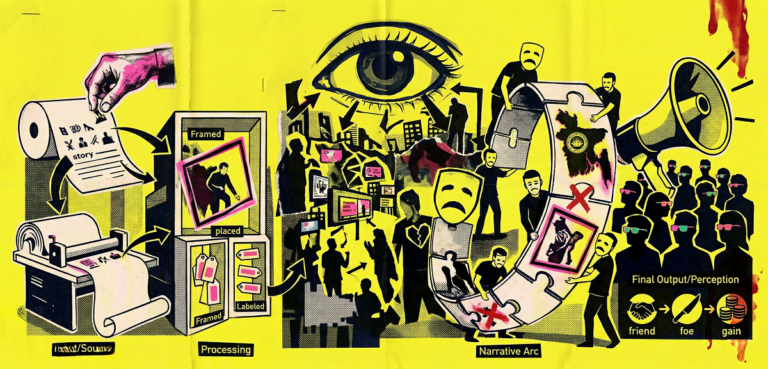
This study examines the structural integrity and narrative construction of a news report published in Amar Desh on April 5, 2026. Using the Structural Integrity Score (SIS) framework, the paper evaluates how framing, sourcing, evidence and language interact to shape public perception. The findings reveal a moderate overall structural score (64.28%), but a high concentration of narrative-driven indicators such as emotional framing, labeling bias and lead framing. The study argues that despite the appearance of professional reporting, the article demonstrates a strong tendency toward perception shaping rather than purely informational journalism.
Metadata Chart
| Variable | Value |
| Media Outlet | Amar Desh |
| Publication Date | April 5, 2026 |
| Article Type | Analysis |
| Topic Category | Politics & Culture |
The metadata indicates that the report belongs to the “analysis” category, which allows for interpretive commentary. However, such classification also increases the responsibility to maintain evidentiary rigor and balanced framing. The timing of publication during a politically sensitive reform period further amplifies the potential influence of the report. Cultural issues in Bangladesh are deeply intertwined with religious identity and national politics, meaning that even subtle framing choices can significantly affect public perception. Therefore, the structural quality of such reporting must be examined carefully.
LFI Chart
| Score | Interpretation |
| 2 / 2 | Strong narrative-driven framing |
The opening section of the article demonstrates a clear departure from neutral informational framing. Instead of beginning with verifiable facts, the report introduces emotionally charged contextual elements such as “post-bloody uprising” and “shadow of cultural aggression.” These phrases are not descriptive in a neutral sense. rather, they function as interpretive constructs that guide the reader toward a specific understanding of the issue.
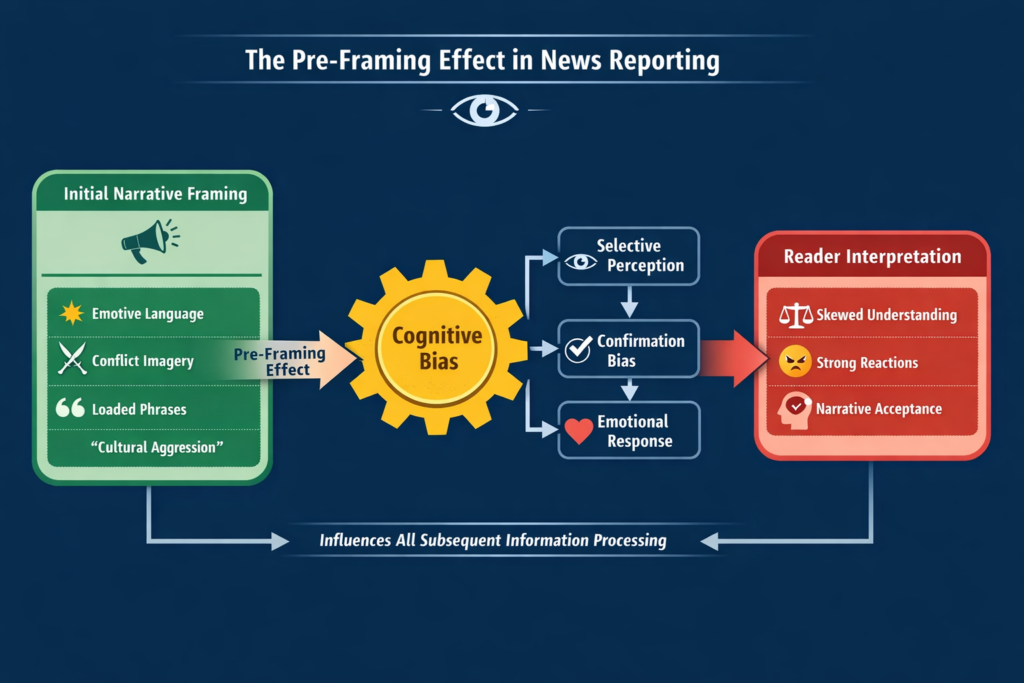
This type of framing creates what media theory identifies as a pre-framing effect, where the audience’s interpretive lens is shaped before factual engagement occurs. Notably, the article omits the eventual conciliatory statement by the minister in its introduction, delaying the presentation of balancing information. As a result, the initial narrative emphasizes conflict and tension, which influences the reader’s cognitive processing of subsequent content.
Such structuring justifies the maximum score for LFI, as the article clearly prioritizes narrative positioning over neutral information delivery.
SDI Chart
| Score | Interpretation |
| 1 / 2 | Limited diversity (absence of independent experts) |
The article incorporates multiple sources, including government officials, religious leaders and unnamed analysts. While this suggests a degree of plurality, the actual diversity of perspectives is limited. The absence of independent cultural experts, such as historians, anthropologists or cultural theorists is particularly significant given the nature of the topic.
Instead, the report relies heavily on politically and ideologically positioned actors, which narrows the analytical scope. Furthermore, references to “analysts” without clear identification introduce ambiguity and weaken source credibility. These unnamed sources contribute to narrative reinforcement rather than independent verification.
As a result, the article presents a dualistic structure, government versus religious actors. without incorporating neutral or third-party perspectives. This limitation justifies a mid-level score of 1.
QDB Chart
| Actor Group | Approx. Share |
| Religious Organizations | 65% |
| Government | 25% |
| Others | 10% |
| Score | Interpretation |
| 1 / 2 | Partial imbalance |
The distribution of quoted material reveals both quantitative and qualitative imbalance. Religious actors dominate the narrative space, not only in terms of frequency but also in rhetorical intensity. Their statements include strong warnings, ideological assertions and emotionally charged language.
In contrast, government responses are limited, often indirect and positioned toward the end of the article. This structural placement reduces their impact and reinforces a defensive posture. Additionally, repeated mentions of the minister’s lack of response subtly frame the government as evasive or unresponsive.
Even though multiple perspectives are present, the imbalance in both volume and narrative emphasis results in a partial but significant distortion of representation. Hence, the score remains at 1.
ESI Chart
| Claim Type | Evidence Type | Score |
| Cultural Blueprint Allegation | Unverified/Unnamed | 0 |
| Indian Influence Claim | Opinion-based | 0 |
| Conspiracy Assertion | Speculative | 0 |
| Minister Statement | On-record | 1 |
| Average Score | 0.25 → Final Score: 0 |
The evidence base of the article is notably weak. Most major claims are not supported by verifiable documentation or corroborated sources. Instead, the report relies heavily on interpretive language and anonymous attribution.
For instance, claims regarding “cultural blueprints” or “Indian ideological influence” are presented without documentary evidence. These assertions function as narrative anchors rather than empirically substantiated facts. Only the minister’s statements qualify as verifiable evidence and they occupy a relatively small portion of the text.
This lack of evidentiary support creates a significant verification deficit, undermining the credibility of the report. As such, the ESI receives the lowest possible score.
EFI Chart
| Emotional Indicators |
| Cultural aggression |
| Deep conspiracy |
| Threat to sovereignty |
| Pollution of identity |
| Score | Interpretation |
| 2 / 2 | High emotional intensity |
The article employs a high density of emotionally charged language, which functions to activate reader sentiment rather than facilitate neutral analysis. Terms such as “cultural aggression” and “threat to sovereignty” are not merely descriptive; they are affective triggers designed to evoke fear, Concern and identity-based reactions.
This emotional framing is consistent throughout the article, appearing in the headline, introduction, and body text. The repetition of such language amplifies its impact, creating a cumulative emotional environment.
From a media effects perspective, this approach shifts audience engagement from cognitive evaluation to emotional response, increasing the persuasive power of the narrative. This justifies the maximum score for EFI.
LDB Chart
| Label Examples |
| Pro-Awami |
| Indian ideological agent |
| Cultural hegemon |
| Score | Interpretation |
| 2 / 2 | Strong labeling bias |
The article demonstrates consistent use of evaluative labels to describe specific actors. These labels are not neutral identifiers; they carry implicit judgment and shape reader perception.
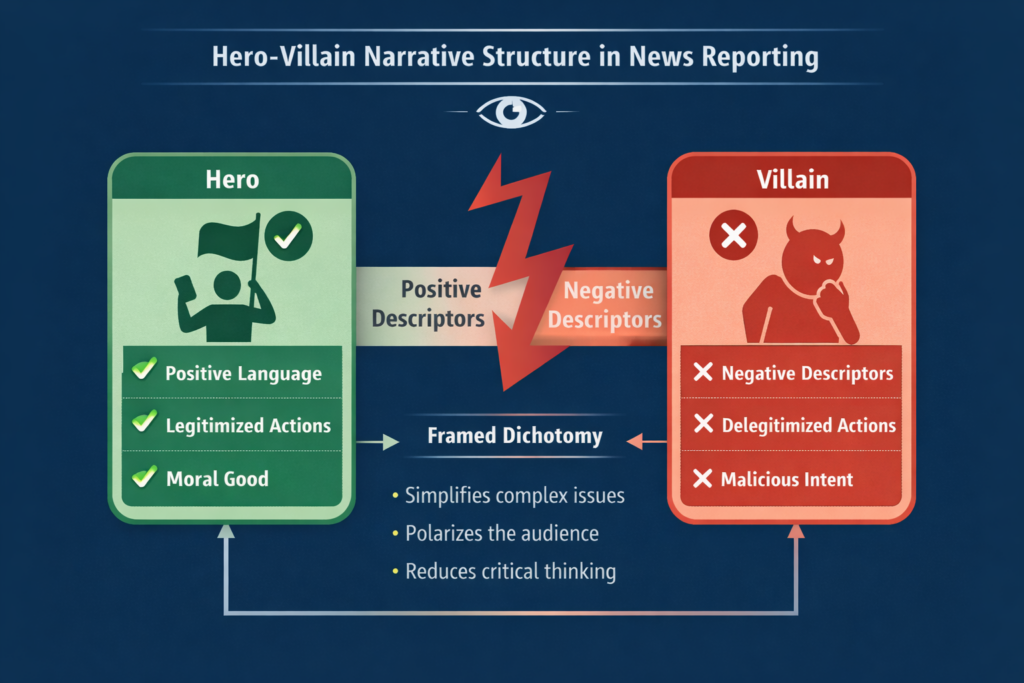
At the same time, opposing actors are framed more positively or neutrally, creating a clear asymmetry. This results in a hero-villain narrative structure, where one side is portrayed as legitimate and the other as problematic.
Such labeling simplifies complex issues into binary moral categories, which can distort nuanced understanding. In this context, labeling functions as aداة of narrative construction rather than objective description.
STI Chart
| Source Type | Presence |
| Named Sources | Partial |
| Anonymous Sources | Frequent |
| Documentary Sources | Absent |
| Score | Interpretation |
| 1 / 2 | Partial transparency |
The article exhibits mixed levels of source transparency. While some actors are clearly identified, many claims rely on vague or anonymous sources. Phrases such as “analysts say” or “a former advisor stated” lack sufficient specificity for independent verification.
The use of anonymous sources is not inherently problematic, but its repeated application, especially in relation to major claims reduces accountability. Without clear attribution, readers cannot evaluate the credibility or bias of these sources.
Thus, the report achieves only partial transparency.
Final Score Chart
| Indicator | Score |
| LFI | 2 |
| SDI | 1 |
| QDB | 1 |
| ESI | 0 |
| EFI | 2 |
| LDB | 2 |
| STI | 1 |
| Total | 9 / 14 |
Final SIS Calculation
| Metric | Value |
| Percentage | 64.28% |
| Category | Moderate Balance |
Although the overall score falls within the “moderate balance” category, the distribution of scores reveals a structural imbalance. High scores in narrative-related indicators (LFI, EFI, LDB) contrast sharply with the low score in evidence strength (ESI).
This creates a structural paradox, where the report appears professionally constructed but is fundamentally driven by narrative elements rather than empirical evidence.
This analysis demonstrates that the examined report operates at the intersection of journalism and narrative construction. While it incorporates factual elements and multiple sources, its structural composition prioritizes framing, emotional engagement, and labeling over verification and neutrality.
Such reporting does not necessarily constitute misinformation, but it does function as a mechanism of perception shaping. In politically and culturally sensitive contexts, this can have significant implications for public discourse, trust in media, and democratic deliberation.
Future reporting in similar contexts should emphasize stronger evidentiary standards, greater source diversity, and more balanced framing to enhance structural integrity and credibility.