
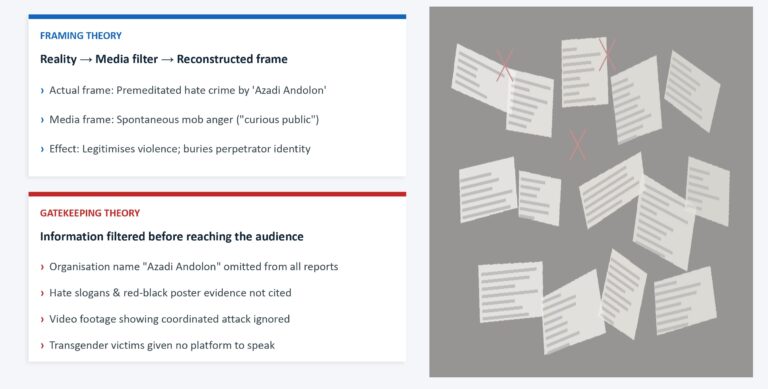
A strategic analysis of the Shahbag incident on the night of 10 April 2026 indicates that a structured gap exists between digital evidence and media representation. While digital evidence points toward the political positioning of a specific organized group, media coverage has framed the event as a spontaneous reaction of “curious crowds” .
Analysis of the available evidence suggests that this was not an immediate clash but rather a pre-planned attack program. According to a digital poster of a group named “Azadi Andolon,” they announced a positioning program at 7:00 PM on 10 April in front of the National Museum in Shahbag, referring to the area as “Hadi Chattar” and calling to “liberate Hadi Chattar from homosexual presence.” While media used the term “National Museum,” the group attempted to assert symbolic control over the space through renaming. Video footage also shows highly aggressive slogans by attackers, which were strategically omitted in media coverage.
This observation follows a mixed-method approach, applying both quantitative and qualitative analysis. Initially, news reports from different media outlets were collected and their headlines, publication times, sources, and visual elements were documented. Subsequently, quantitative content analysis was used to measure framing patterns, source diversity, and coverage trends.
The following media outlets were included in this analysis:
| Media | Type | Archive Link |
| Asia Post | Online | https://archive.ph/WZbVr |
| Desh TV | Television | https://archive.ph/mYqNu |
| Bhorer Kagoj | Newspaper | https://archive.ph/eBneQ |
| BanglaNews24 | Online | https://archive.ph/HTxvp |
| Kalbela | Online | https://tinyurl.com/5dsejvn9 |
These media outlets were selected because they were among the first to publish and circulate the news, making their role significant in the narrative-setting stage. However, this selection is based on early coverage and does not represent the entire media landscape.
Event Coverage Documentation Table
| Media | Time | Headline Pattern | Frame Type |
| Asia Post | 09:25 PM | Curious Crowd | Conflict Frame |
| Desh TV | 10:08 PM | Tension | Conflict Frame |
| Kalbela | 10:33 PM | Altercation | Soft Conflict |
| BanglaNews24 | 10:39 PM | Curious Crowd | Conflict Frame |
| Bhorer Kagoj | 10:54 PM | Attack/Clash | Mixed Frame |
Different media outlets presented the same event using varied language and frames. In some cases, the event was described as “curious crowds” or “tension,” while others used terms like “attack” or “clash.” This variation creates the possibility of multiple interpretations of the same event.
These differences indicate that language selection and framing play a significant role in news representation. However, this observation is based on a limited number of reports and should be considered indicative rather than conclusive.
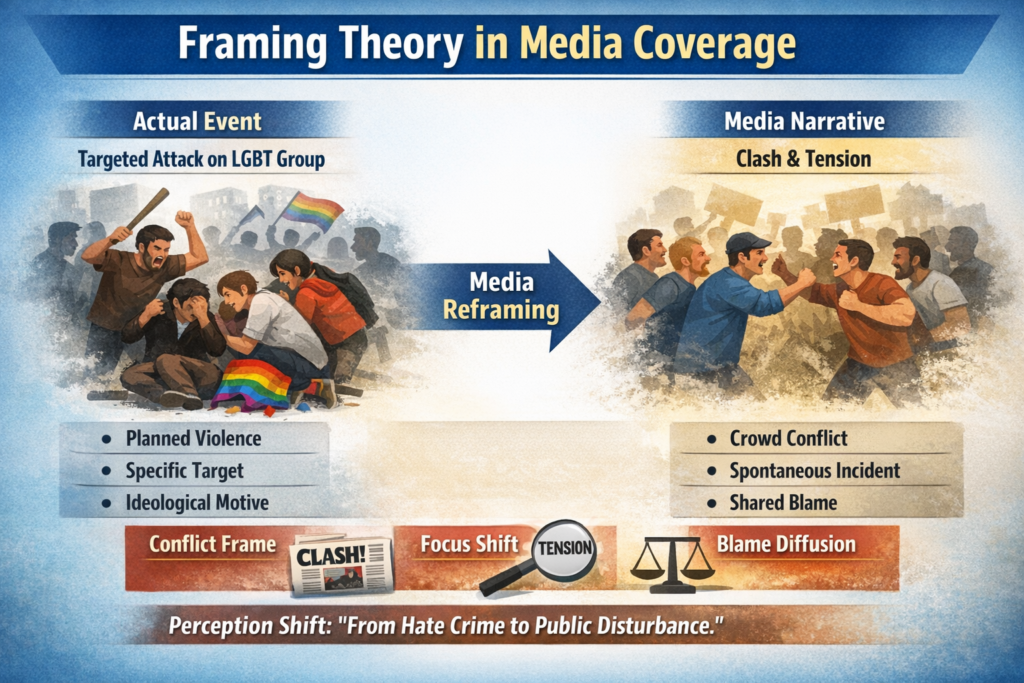
According to framing theory, media can alter the interpretation of an event through selective wording. The same event is presented in two ways: as targeted violence in reality, and as a general “clash” or “tension” in media coverage. This demonstrates how language and presentation can reshape public understanding.
This analysis is conceptual and does not aim to assign intent to any specific media outlet, but rather to illustrate the broader impact of framing.
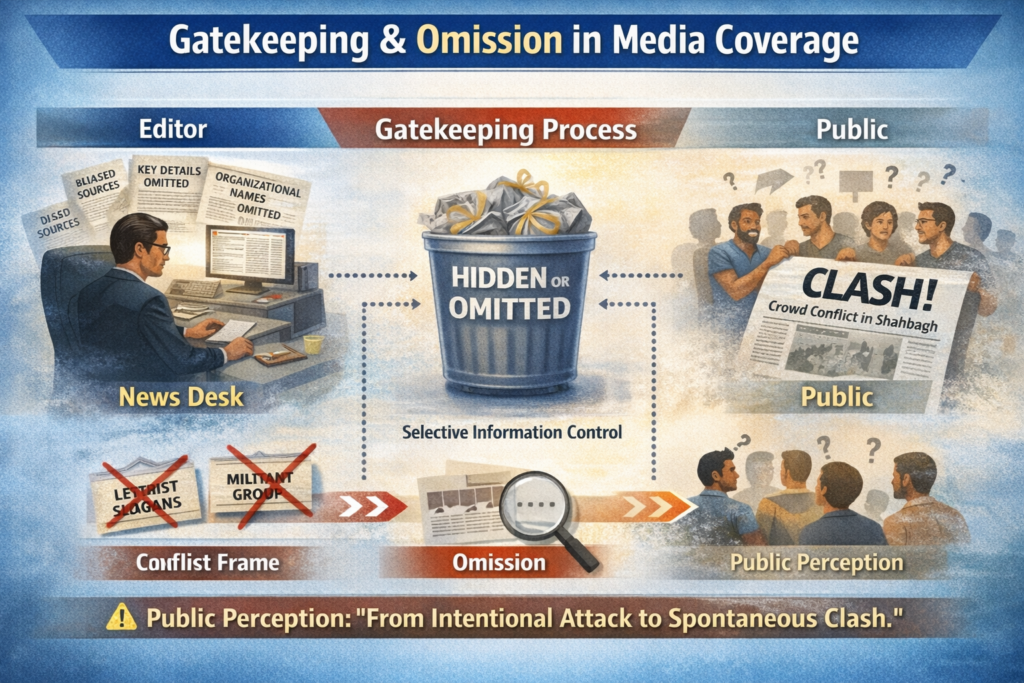
The visual representation of gatekeeping and omission illustrates how information is filtered before publication. Certain elements, such as organizational identity, slogans, or contextual background, may be excluded from news coverage.
As a result, the final representation may present a partial or limited reality, potentially influencing how audiences interpret the event. This is a general analytical observation and not directed at any single media outlet.
Additionally, media coverage shows signs of victim-blaming, where quotes from a witness (Abid) referencing “discomfort with family presence” or “obscene gestures” were included. This may indirectly reinforce the narrative of the attackers by amplifying their justification.
| Index | Score (0–2) | Observation |
| HFI | 2 | Strong framing |
| SDI | 1 | Limited sources |
| ESI | 1 | Limited evidence |
| OI | 2 | Significant omission |
The indices used in this report are designed to systematically evaluate different aspects of news coverage. Each index is scored on a 0–2 scale, where 0 indicates low or neutral presence, 1 indicates partial presence, and 2 indicates strong presence.
HFI (Headline Framing Index) measures the level of framing in headlines. Words like “clash,” “curious crowd,” or “tension” were considered indicative of stronger framing.
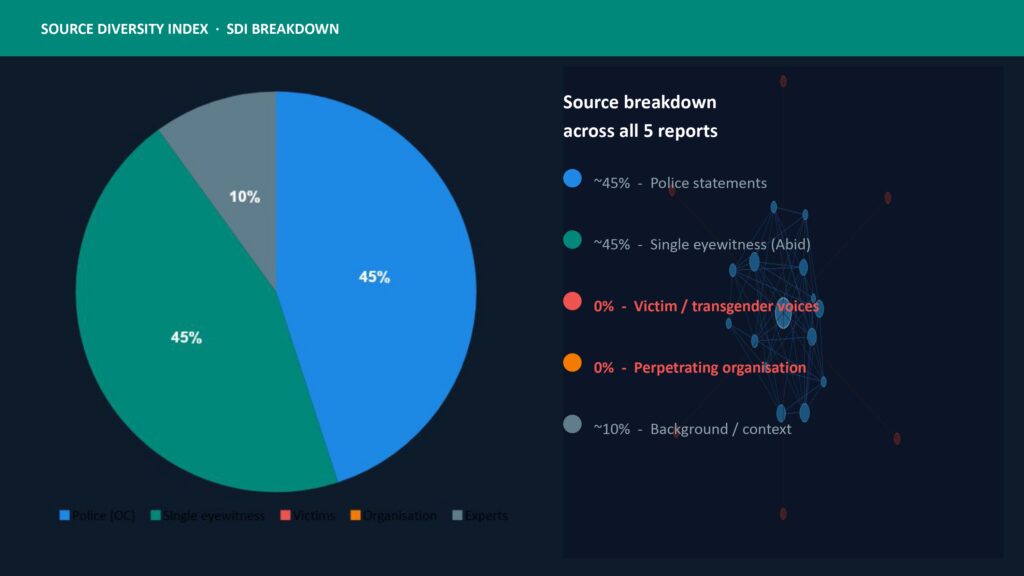
SDI (Source Diversity Index) evaluates the variety of sources used. Reports relying on similar or limited perspectives were scored lower.
ESI (Evidence Strength Index) assesses the level of supporting evidence. Reports lacking verifiable documents or visual proof were considered to have limited evidence.
OI (Omission Indicator) identifies whether key contextual information was excluded, such as organizational identity, slogans, or pre-event planning.
Together, these indices provide a structured understanding of how balanced or partial the coverage is. However, they are analytical tools and do not represent final conclusions..
| Media | Tone | Source | Evidence Strength |
| Asia Post | Negative | Abid + OC | Weak |
| Desh TV | Critical | Witness | Weak |
| Bhorer Kagoj | Partially Neutral | Abid | Moderate |
| BanglaNews24 | Negative | Staff Reporter | Weak |
| Kalbela | Negative | OC + Witness | Weak |
The narrative matrix indicates a notable similarity across media outlets in terms of tone, source selection, and evidence use. Most reports rely on limited sources, often from similar perspectives, which reduces narrative diversity.
The lack of strong evidence and independent verification suggests a convergence of narratives across outlets. However, this observation is indicative and based on selected reports.
| Time | Media | Role |
| 09:25 | Asia Post | Primary narrative setter |
| 10:08 | Desh TV | Follow-up |
| 10:33 | Kalbela | Repetition |
| 10:39 | BanglaNews | Repetition |
| 10:54 | Bhorer Kagoj | Follow-up |
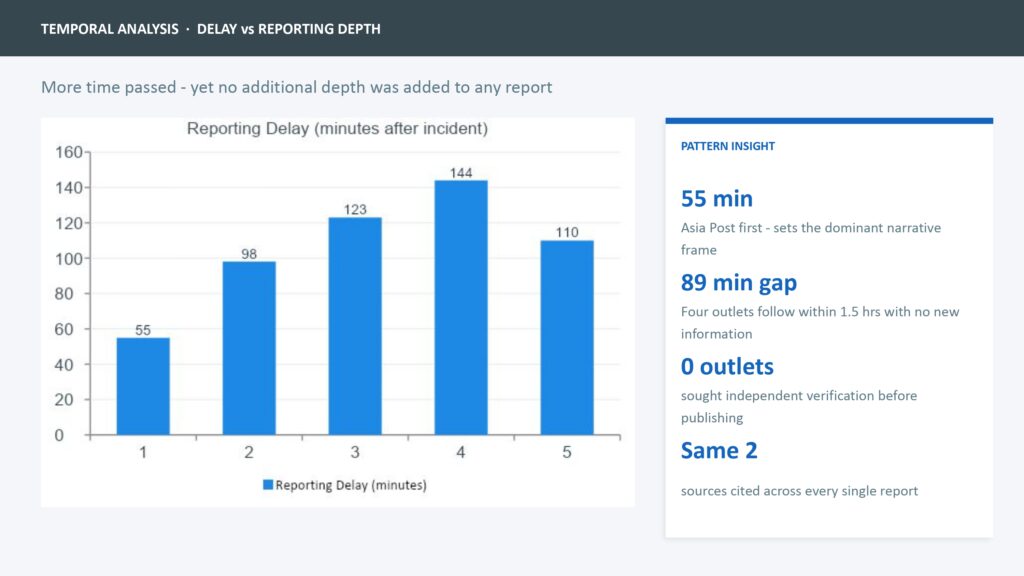
Timeline analysis shows that the first report was published shortly after the event, followed quickly by others. This suggests rapid information flow.
Subsequent reports show similarities in language and framing, indicating possible influence from early coverage. However, it cannot be conclusively stated that all outlets lacked independent verification. Rather, it suggests a potential pattern of narrative replication common in fast-paced news environments.
Based on source-context analysis, it can be argued that mainstream media coverage did not fully reflect the structured nature of the incident. The use of terms like “curious crowd” may have partially obscured the organized aspect of the event, creating a gap between digital evidence and media reporting.
This gap highlights a broader concern regarding how complex events are simplified in media narratives, which may influence public understanding of the incident.