
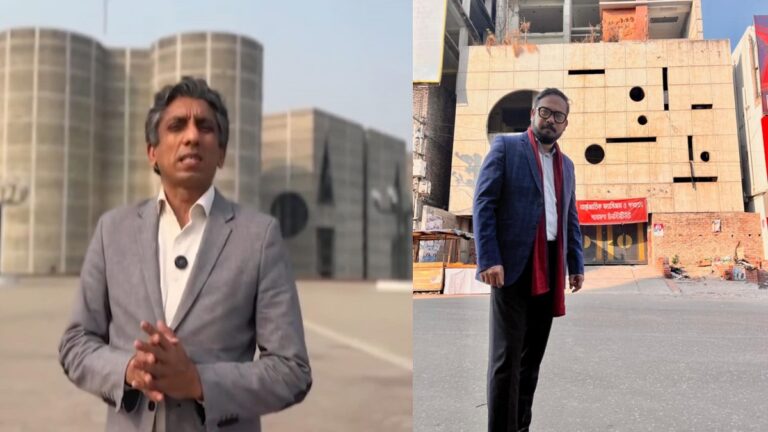
By communicating with the message delivered at the press conference of BNP Chairman and incoming Prime Minister Tarique Rahman, whose party was elected in Bangladesh’s 13th National Election, as well as with BNP political leaders, journalists and media from two conflict-prone South Asian countries, India and Pakistan, have attempted to produce analyses regarding relations with their respective countries. The analyses of the media and journalists from both countries have been monitored by Bangladesh Media Monitor’s South Asia Monitor Chronicler, Ayaz Rahman.
Pakistani journalist Ejaz Saeed, following the press conference of BNP Chairman and incoming Prime Minister Tarique Rahman, whose party was elected in Bangladesh’s 13th National Parliament, published an analytical report in his country’s media outlet Geo News. In the report, Bangladesh’s political shift and the new government have been presented as positive for Pakistan’s diplomatic prospects.
This Pakistani journalist reported in Geo News that India maintaining communication for a long period exclusively with Sheikh Hasina’s government and the Awami League created tensions in Bangladesh-India diplomatic relations. This, according to the report, has opened a positive opportunity for Pakistan.
However, in his press conference, Tarique Rahman repeatedly conveyed a unified message regarding diplomatic relations with India, Pakistan, and China, stating that Bangladesh would build diplomatic relations with all countries based on Bangladesh’s national interests. He also stated that there would be no special or exclusive relationship with any country at a personal level.
Nevertheless, the Geo News journalist attempted to interpret Tarique Rahman’s message positively. The journalist suggested that the type of relationship India had with Bangladesh during Sheikh Hasina’s tenure, from which India gained various advantages, may not continue in the same way under the new government. This perspective was presented by the Pakistani journalist reporting from Dhaka.
Additionally, during his visit to Dhaka, the journalist spoke with ordinary citizens of Bangladesh to understand the cultural exchanges between Pakistan and Bangladesh beyond political relations. He also attempted to understand the reasons behind anti-India sentiment in Bangladesh. In his report, he stated that anti-India sentiment in Bangladesh is primarily rooted in grievances against India’s political influence and empowerment, rather than hatred toward India as a whole.
Furthermore, the Geo News journalist asked Tarique Rahman about reviving SAARC during the press conference. Tarique Rahman responded positively regarding the revival of SAARC. The Pakistani journalist highlighted this in his report, presenting SAARC’s role as positive for regional politics and relationship building among India, Pakistan, and Bangladesh.
Meanwhile, following Tarique Rahman’s press conference, Indian media also published various analyses regarding Bangladesh’s new government. At first glance, Indian media outlet India Today presented the Bangladesh Nationalist Party (BNP) as a comparatively liberal and democratic political alternative compared to Jamaat-e-Islami. At the same time, it presented the “golden era” of India-Bangladesh relations during Sheikh Hasina’s tenure as having ended.
Additionally, the Indian media outlet mentioned the possibility of normalization of relations after the tensions that emerged during the interim government led by Professor Muhammad Yunus.
Indian media outlets have also repeatedly presented the phone conversation between Indian Prime Minister Narendra Modi and Tarique Rahman, as well as Modi’s congratulatory message, as positive diplomatic signals.
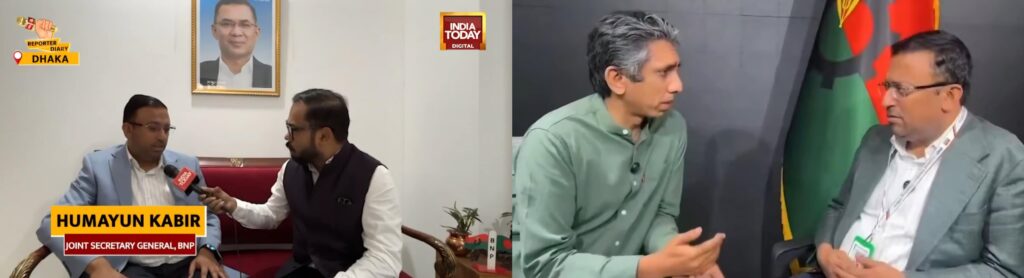
Furthermore, journalists from both Pakistan’s Geo News and India’s India Today interviewed Humayun Kabir, advisor to Tarique Rahman and BNP Joint Secretary. Journalists from both countries asked questions about Sheikh Hasina from their respective diplomatic perspectives.
However, the discomfort surrounding Sheikh Hasina’s presence in Delhi and its implications for Bangladesh-India relations was also reflected in the behavior of India Today journalist Indrajit Kundu. After the press conference, Tarique Rahman’s advisor Humayun Kabir spoke with both journalists about Sheikh Hasina’s return and her presence in Delhi.
At the same time, it appears that Indian media may attempt, as before, to exert pressure on the new government by raising issues related to minority communities or alleged attacks and persecution of Hindus in Bangladesh, whether factual or propaganda-driven.
On the other hand, while such propaganda-related narratives from Indian media may negatively impact Bangladesh-India relations by creating tensions, Pakistani media journalism appears to be attempting to move closer to Bangladesh. This may play a positive role in strengthening Pakistan-Bangladesh relations.