
Ayaz Rahman is the Sam Chronicler of Bangladesh Media Monitor.
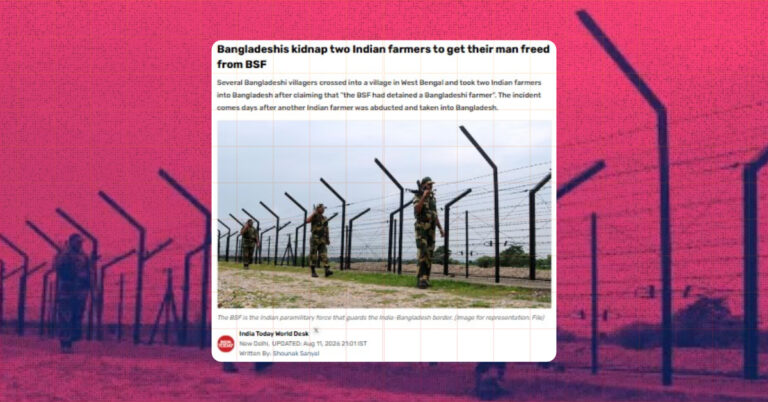
The India Today report, “Bangladeshis kidnap two Indian farmers to get their man freed from BSF,” covers a sensitive India–Bangladesh border incident in which two Indian farmers from West Bengal were reportedly taken across the international border by Bangladeshi villagers following the alleged detention of a Bangladeshi farmer by the BSF.
The report takes a conflict-oriented but largely attribution-based news approach. It presents the incident as a reciprocal chain of detention and abduction: a Bangladeshi farmer is allegedly detained by the BSF, Bangladeshi villagers then cross the border and take two Indian farmers, and a subsequent BSF–BGB flag meeting results in the return of the individuals.
The report is stronger than a purely narrative or advocacy-oriented article because it uses multiple named media sources and includes an official BGB statement. However, it remains asymmetrical in source representation, particularly because the BSF, Indian administration and the abducted Indian farmers themselves are not directly quoted.
Analysis of the Headline
Headline: “Bangladeshis kidnap two Indian farmers to get their man freed from BSF”
The headline is highly consequential because it establishes the reader’s interpretation before the article begins.
The headline uses an action–reaction frame
The structure is essentially:
Bangladeshis kidnap Indians → in order to free a Bangladeshi detainee
This gives the incident a clear causal narrative. Rather than simply reporting that two Indian farmers were taken across the border, the headline immediately explains the alleged motivation.
The phrase “to get their man freed” makes the relationship particularly explicit. It portrays the Bangladeshi farmer as belonging to a group and the subsequent abduction as a retaliatory action undertaken on his behalf.
“Bangladeshis” is a broad collective label
The use of “Bangladeshis” rather than “Bangladeshi villagers” or “a group of Bangladeshi villagers” is notable.
The actual report describes a particular group of villagers/relatives. Therefore, the headline potentially broadens the actors from specific individuals to a national identity.
This does not necessarily make the headline factually incorrect, but it can create a stronger national or inter-community conflict frame.
“Kidnap” is a strong and definitive word
“Kidnap” is considerably more forceful than neutral alternatives such as:
- “take”
- “detain”
- “take across the border”
- “hold”
The article itself contains qualifying language such as “reportedly” and “allegedly”, but the headline uses the categorical verb “kidnap.”
This produces a small tension between the headline’s certainty and the body’s more qualified reporting.
“Their man” is informal and adversarial
The expression “their man” is especially noteworthy.
It is not a neutral description such as “the Bangladeshi farmer” or “the detained farmer.” It creates an us-versus-them frame:
“their man” vs “two Indian farmers.”
Consequently, the headline has a stronger conflict orientation than the body of the report.
Headline assessment
Overall, the headline is:
Conflict-oriented + causal + national-identity framed + somewhat emotionally charged.
It is effective as a news headline because it communicates the alleged motivation immediately, but it is less neutral than the article body.
Approach of the News Report
The article adopts a chronological escalation-and-resolution approach.
The narrative can be broken down into four stages:
Stage 1 — Alleged BSF detention
The report begins with the alleged detention of 70-year-old Bangladeshi farmer Abdul Mannan while he was working near the border.
Stage 2 — Retaliatory action
It then describes Bangladeshi villagers crossing the international border and taking two Indian farmers.
Stage 3 — Official border-force intervention
The report introduces the BSF–BGB flag meeting.
Stage 4 — Resolution
It ends this immediate episode by reporting that the three individuals were returned to their respective countries.
This structure gives the story a clear cause → retaliation → negotiation → resolution trajectory.
The Report Is Not Entirely One-Sided
It would be inaccurate to classify the report as completely one-sided.
Several features improve its balance:
- It cites Prothom Alo and The Daily Star rather than relying entirely on unnamed sources.
- It identifies Ibrahim Khalilullah by name and relationship.
- It quotes BGB Battalion Commander Lieutenant Colonel Nazmul Hasan.
- It reports the outcome of the BSF–BGB flag meeting.
- It acknowledges discrepancies between the two Bangladeshi reports regarding the identities of the Indian farmers.
- It repeatedly uses terms such as “allegedly” and “reported.”
These are important indicators of conventional news-reporting practice.
However, balance is still incomplete because the Indian side is largely represented indirectly, rather than through direct testimony.
Major Source-Balance Problem
The most important weakness is the absence of a direct Indian-side voice.
The article does not provide:
- a direct BSF statement;
- an Indian government statement;
- a West Bengal police statement;
- a statement from either of the allegedly abducted Indian farmers;
- a statement from the Indian farmers’ families.
The Bangladeshi side, by contrast, receives several identifiable voices.
This creates an asymmetry of source access.
The article therefore does not necessarily promote a false narrative, but it gives the reader substantially more direct information about the Bangladeshi explanation of events than the Indian explanation.
Source Attribution and Evidence
A significant strength is the distinction between what the publication knows directly and what other media outlets report.
For example, the article repeatedly attributes information to Prothom Alo and The Daily Star.
This is preferable to presenting all claims as independently established facts.
However, there is a potential secondary-source dependency.
A large portion of the factual narrative is derived from Bangladeshi media reporting. The article would have been considerably stronger if it had independently verified the central claims through:
- BSF;
- BGB;
- local police;
- the families of the Indian farmers;
- border officials;
- photographs/video;
- official records of the flag meeting.
Thus, the evidence base is substantial enough for a news report but not comprehensive enough for strong independent verification.
Identity Discrepancy
An important journalistic issue is the discrepancy concerning the names of the two Indian farmers.
The article reports:
Prothom Alo:
- Sachin Karmakar
- Narayan Deb
The Daily Star:
- Sachin Das
- Ratan Biswas
This is actually one of the stronger aspects of the report because India Today does not conceal the discrepancy.
However, it also demonstrates why independent verification would have been useful.
When the identities of the central subjects differ between two sources, an ideal follow-up would seek confirmation from the BSF, police or the individuals’ families.
Contextual Framing
The article does more than report the immediate incident. It connects it to the earlier abduction of Dipankar Gope, an Indian tea farmer from Jalpaiguri.
This creates a broader narrative:
Bangladeshi farmer detained → Indian farmer abducted → another Bangladeshi farmer detained → two Indian farmers taken.
This contextual approach helps the reader understand that the incident may not be isolated.
However, it also creates a potential framing risk: connecting separate incidents can encourage the reader to interpret them as a single escalating pattern even when the causal relationship between each event has not been independently established.
The report partly mitigates this through words such as “reportedly” and “allegedly,” but stronger independent verification would improve the contextual analysis.
Emotional and National Framing
Compared with openly advocacy-oriented reporting, the body of the article is relatively restrained.
It does not contain extensive moralising language or repeated descriptions of one community as inherently violent.
Nevertheless, the headline and certain phrases create a clear national confrontation frame.
The repeated references to:
- Indian farmers;
- Bangladeshi villagers;
- BSF;
- BGB;
- crossing the international border;
- abduction;
- detention;
make the national identities of the actors central to the story.
That is understandable in a border-security story, but it also increases the possibility of India-versus-Bangladesh framing.
9. Graphs
| Indicator | Score | Assessment |
| LFI — Lead Framing Index | 1/2 | Headline has strong conflict framing, while the body uses attribution and qualification |
| SDI — Source Diversity Index | 1/2 | Multiple media sources and BGB official, but limited Indian-side sourcing |
| QDB — Quote Distribution Balance | 1/2 | Bangladeshi relative and BGB official quoted; Indian direct voices absent |
| ESI — Evidence Strength Index | 1/2 | Multiple reports and official BGB account, but limited independent verification |
| EFI — Emotional Framing Index | 1/2 | Strong terms such as “kidnap” and “abducted,” but relatively restrained body |
| LDB — Labeling & Descriptor Bias | 1/2 | “Bangladeshis” and “their man” create some collective/adversarial framing |
| STI — Source Transparency Index | 2/2 | Named publications, named individual source and named BGB commander |
Total Score
1 + 1 + 1 + 1 + 1 + 1 + 2 = 8/14
Final Composite Index
[ FCI/SIS = (8/14)\times100 ]
[ \mathbf{FCI/SIS = 57.14%} ]
Final Score
SIS / FCI = 57%
Classification: Moderate Imbalance
Overall Assessment
The India Today report is best understood as a conflict-oriented news report rather than an overtly propagandistic or advocacy article.
Its strongest journalistic characteristics are source attribution, chronological reporting, multiple named sources, acknowledgement of conflicting names, and inclusion of an official BGB account.
Its main weakness is source asymmetry. The report gives the Bangladeshi side identifiable voices but does not provide a comparable direct response from the BSF, Indian authorities, or the affected Indian farmers.
The headline is more problematic than much of the body. “Bangladeshis kidnap two Indian farmers to get their man freed from BSF” compresses a complicated and partly disputed sequence into a highly direct causal statement. The words “Bangladeshis,” “kidnap,” and “their man” create a strong collective and adversarial frame. A more neutral headline would distinguish the specific actors from the wider Bangladeshi population and retain the alleged nature of the causal link.
Overall, the report contains more sourcing and evidence than a clearly one-sided report, but it does not achieve full source or quote balance. Under the supplied codebook, 57% is therefore a reasonable assessment: moderately imbalanced, with the principal weakness being incomplete Indian-side representation rather than an absence of sourcing altogether.
Visual Bias Module
Not scored.
No photographs, captions, graphics or video accompanying the article were supplied for analysis. A VBM assessment would require the actual visual material and its captions.