
Executive Summary
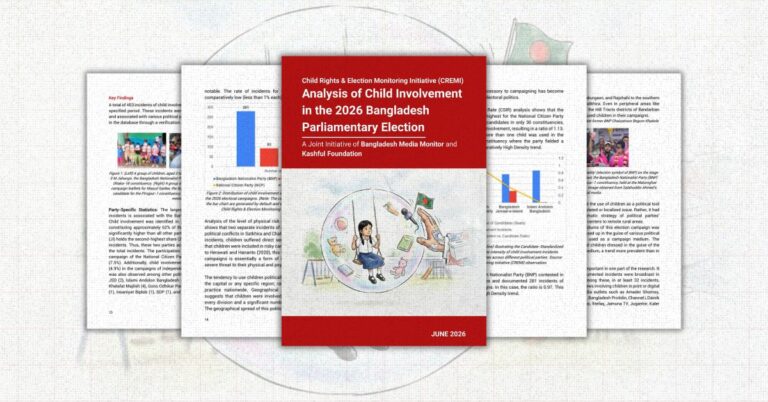
This observation was conducted under the Child Rights & Election Monitoring Initiative (CREMI), a joint initiative of Bangladesh Media Monitor and Kashful Foundation. It documented and analyzed over 450 specific incidents of child involvement in electoral campaigns during the official campaign period (January 22, 2026 to February 10, 2026) for the Thirteenth National Parliamentary Election in Bangladesh. The primary objective of the research was to assess the use of children in electoral politics, associated risks, and party-specific trends. This study primarily employed an incident-based quantitative monitoring methodology to analyze the nature and extent of children’s political exploitation.
Out of the total 453 incidents documented, the largest share was associated with the campaigns of the Bangladesh Nationalist Party (BNP) (281), Bangladesh Jamaat-e-Islami (JI) (93), and National Citizen Party (NCP) (34). Twenty-two incidents were also identified in the campaigns of independent candidates. Additionally, 23 incidents were identified in the campaigns of other political parties and the referendum campaign. The documented incidents include 2 cases of child fatalities and 2 cases of serious physical injury, indicating the involvement of children in a high-risk political environment.
Analysis of the patterns of child involvement revealed two main forms: (a) direct political participation and (b) symbolic or performative involvement. First, a significant number of children were directly engaged in political activities, where they participated in processions, rallies, and street corner meetings, providing slogans, carrying banners or placards, or ensuring a visible presence beside the candidate. Second, in many incidents, children were observed performing symbolic or performative roles, such as carrying party flags, drawing symbols on their cheeks, wearing specific colored or symbolic attire, participating in political songs or poems, and inclusion in promotional photos and videos.
Age-based analysis suggests that in most cases, the children involved were relatively young, with a higher presence of children under 10 years old across almost all-party campaigns. Reports of child fatalities in political violence in Satkhira and Chattogram clearly indicate the direct risk of this involvement.
The overall analysis suggests that the tendency to use children in electoral campaigns is not limited to a single party but is a clear cross-party phenomenon. While the number of incidents is higher for larger parties, similar behavior is observed among smaller parties and independent candidates. This trend reflects a structural political culture where children are used as instruments to generate sympathy or as a strategy to increase the visibility of the campaign. Consequently, it is not an isolated incident but a recurring and institutionalized electoral behavior.
However, as this study relies primarily on media and observation-based sources, there is a possibility of underreporting of some incidents. Due to constraints of time and resources, not all information could be verified in the field. Furthermore, long-term trends could not be analyzed due to the specific timeframe. There are plans to publish a more extensive and verified study in the future to overcome these limitations.
A more nuanced picture emerges from the analysis of the Candidate-Standardized Incident Rate (CSIR), which measures the proportional intensity of incidents relative to the number of candidates. In this analysis, the intensity of child use was highest for the National Citizen Party (NCP) (1.13), and high for the Bangladesh Nationalist Party (BNP) (0.97). Conversely, Islami Andolon Bangladesh, despite fielding a large number of candidates, maintained the lowest rate of child involvement (0.01). This discrepancy indicates that the use of children is not solely dependent on party size but is a structural campaign strategy.
The extent of child involvement in high-risk environments is alarming; direct physical violence components were present in approximately 5.2% of the documented incidents. The incidents of child fatalities and serious injuries (in Satkhira and Chattogram) reflect a direct threat to children’s physical safety amidst electoral tension. In this context, the use of children as ‘rhetorical tools’ in political campaigns and, in some cases, as ‘human shields’ in illegal gatherings, constitutes a clear violation of child rights.
Based on the data, specific policy measures are necessary to prevent the political exploitation of children. The Election Commission (EC) must define the political use of children as a clear ‘punishable offense’ in their code of conduct and include it as a performance indicator in their own monitoring cell. Political parties should appoint ‘Child Protection Focal Points’ at the organizational level and provide training to grassroots workers. Simultaneously, law enforcement agencies must formulate a ‘Standard Operating Protocol (SOP)’ to safely remove children from conflict-prone areas, and media outlets should follow sensitive reporting protocols, including ‘face-blurring’ technology to protect children’s identities. Overall, this research confirms that the use of children in electoral campaigns is a clear violation of the ‘Children Act, 2013’ and the United Nations Convention on the Rights of the Child (UNCRC). An immediate multi-stakeholder solution is required to move away from this trend.