
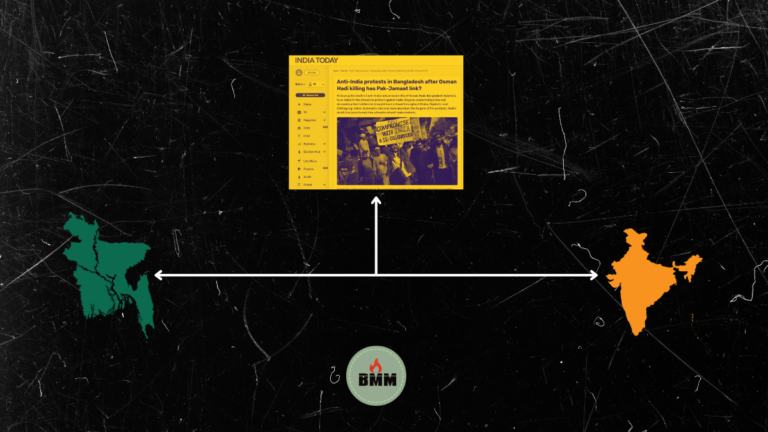
Ayaz Rahman: This report presents a structured content analysis of an article published by India Today on 3 March 2026 titled “Anti-India protests in Bangladesh after Osman Hadi killing has Pak-Jamaat link?”. The study evaluates how the report frames the killing of Sharif Osman Hadi and the subsequent protests in Bangladesh, focusing on journalistic structure rather than the factual accuracy of the claims presented.
The analysis employs a quantitative content analysis framework combined with qualitative interpretation to evaluate the structural characteristics of the selected news article. Seven analytical indicators are used to assess the structural integrity of the report: Lead Framing, Source Diversity, Quote Distribution Balance, Evidence Strength, Emotional Framing, Labeling Bias, and Source Transparency.
| Score | Meaning |
| 0 | Weak or absent presence |
| 1 | Moderate or partial presence |
| 2 | Strong presence |
Each indicator is coded using a three point scoring scale. A score of 0 indicates weak or absent presence of the indicator, 1 indicates moderate or partial presence and 2 indicates strong presence. The scores across all seven indicators are aggregated to produce an overall structural assessment of the article.
The maximum possible score across all indicators is 14, which represents the highest level of structural presence within the analytical framework.
Lead Framing Index (LFI)
| Component | Observation |
| Headline framing | The headline frames the event through a geopolitical lens by linking protests to Pakistan and Jamaat. |
| Introductory description | The article describes Sharif Osman Hadi as an “anti-India radical leader” and “India-baiter”. |
| Narrative implication | Ideological characterization appears before full factual context is presented. |
| Analytical interpretation | Early framing encourages readers to interpret the event primarily through anti-India political mobilisation. |
| Score | 2 (Strong presence of narrative framing) |
The headline and introductory section of the article contain a clear narrative framing of the event. The report describes Sharif Osman Hadi using terms such as “anti-India radical leader” and “India-baiter”, which introduce a strong ideological characterization at the very beginning of the story.
These descriptors appear before a full factual explanation of the killing and the subsequent protests is provided. As a result, the opening structure of the report places the event within a predefined interpretive framework that emphasises anti-India political mobilisation and possible geopolitical alignments.
Such early framing can shape how readers interpret the incident before the complete contextual details are presented. Based on the analytical criteria used in this study, the Lead Framing Index is therefore assessed as showing a strong presence of narrative framing (Score: 2).
Source Diversity Index (SDI)
| Source Category | Presence |
| Indian diplomatic sources | Former ambassador Veena Sikri |
| Indian political sources | Rajya Sabha MP Harsh Vardhan Shringla |
| Analytical commentary | Columnist Zeba Zoariah |
| Government institutional source | Indian Ministry of External Affairs |
| Bangladeshi institutional source | Dhaka Metropolitan Police |
| Missing perspectives | Bangladeshi political actors, independent scholars, international analysts |
| Score | 1 (Moderate diversity but geographically imbalanced) |
The article includes several identifiable sources from different institutional and analytical backgrounds. These include former Indian ambassador Veena Sikri, Rajya Sabha Member of Parliament and diplomat Harsh Vardhan Shringla, columnist Zeba Zoariah, statements from the Indian Ministry of External Affairs, and information attributed to the Dhaka Metropolitan Police. The presence of named sources and institutional affiliations provides a degree of source transparency within the report.
However, the distribution of sources appears geographically and politically concentrated. Most analytical and interpretive perspectives originate from Indian diplomatic or political viewpoints, while direct perspectives from Bangladeshi political actors, protest participants, independent scholars or international analysts are largely absent. As a result, although the report includes multiple identifiable sources, the range of perspectives remains limited. Based on the analytical criteria used in this study, the Source Diversity Index is therefore assessed as moderate (Score: 1).
Quote Distribution Balance (QDB)
| Actor Category | Representation in Quotes |
| Indian officials / diplomats | High |
| Indian commentators / analysts | High |
| Bangladeshi government officials | Limited |
| Protest participants | Absent |
| Independent international experts | Absent |
| Narrative balance | Strong asymmetry in quoted voices |
| Score | 0 (Clear imbalance in quotation distribution) |
An examination of the quotation patterns within the article indicates a clear concentration of quoted voices from a limited set of actors. Most direct quotations are attributed to Indian officials, diplomats, and commentators, including policy figures and analytical commentators discussing the political implications of the protests. These perspectives contribute significantly to the interpretive framework presented in the report.
In contrast, direct quotations from Bangladeshi political actors, protest participants or independent international analysts are largely absent. While the article references developments within Bangladesh, the limited presence of locally sourced voices results in an uneven distribution of quoted perspectives. Based on the analytical criteria applied in this study, the Quote Distribution Balance is therefore assessed as limited, indicating a clear asymmetry in quotation representation (Score: 0).
Evidence Strength Index (ESI)
| Claim Type | Evidence Basis |
| Pakistan–Jamaat geopolitical linkage | Analytical commentary |
| Characterisation of protests | Interpretive statements |
| Law enforcement information | Dhaka Metropolitan Police statement |
| Verifiable documentation | Limited |
| Overall evidence strength | Moderate reliance on opinion-based analysis |
| Score | 1 (Partial evidence support) |
The article presents several claims regarding the political context and possible geopolitical implications surrounding the protests following the killing of Sharif Osman Hadi. Some of these claims, particularly those suggesting connections between Jamaat-e-Islami and broader Pakistani geopolitical influence, appear to rely primarily on analytical commentary and interpretive assessments rather than on clearly documented or independently verifiable evidence.
At the same time, the report includes at least one institutional reference, citing a statement from the Dhaka Metropolitan Police indicating that investigators did not find evidence suggesting that the attackers had fled to India. While the presence of identifiable institutional information contributes to the evidentiary basis of the report, the broader geopolitical interpretations remain supported largely by expert opinion and analytical inference. Based on the criteria used in this study, the Evidence Strength Index is therefore assessed as moderate, indicating partial evidentiary support (Score: 1).
Emotional Framing Index (EFI)
| Language Example | Narrative Effect |
| “Radicals” | Delegitimises political actors |
| “India-baiter” | Personalised ideological framing |
| “Spew venom” | Highly emotive expression |
| “Islamist-infiltrated protests” | Suggests ideological threat |
| “Manufactured outrage” | Implies artificial mobilisation |
| Score | 2 (Strong emotional framing) |
An examination of the language used in the article indicates the presence of emotionally charged expressions that shape the narrative tone of the report. Several descriptors used in the text, such as “radicals,” “India-baiter,” “spew venom,” “Islamist-infiltrated protests,” and “manufactured outrage” carry strong evaluative or emotive connotations. The repeated use of such expressions contributes to a narrative environment in which political actors and events are framed through emotionally loaded terminology rather than through strictly descriptive language.
While such language can appear in political reporting, its frequency within the article may influence how readers interpret the motivations and legitimacy of the actors involved in the protests. Based on the analytical criteria applied in this study, the Emotional Framing Index indicates a strong presence of emotive narrative language (Score: 2).
Labeling Bias Index (LBI)
| Label Used | Target Actor | Narrative Implication |
| “Anti-India radical leader” | Sharif Osman Hadi | Ideological delegitimisation |
| “Islamist radicals” | Protest actors | Security framing |
| “Pro-Pakistan Islamists” | Political organisations | Geopolitical alignment framing |
| Repetition frequency | Multiple references | Reinforces narrative interpretation |
| Score | 2 (Strong labeling bias) |
The article repeatedly employs evaluative labels when referring to certain individuals and political actors connected to the protests. Descriptions such as “anti-India radical leader,” “Islamist radicals,” and “pro-Pakistan Islamists” are used to characterise individuals and groups within the narrative. These descriptors introduce interpretive framing by associating actors with particular ideological or geopolitical positions.
The recurring use of such labels may shape how readers perceive the motivations and affiliations of the actors involved in the events being reported. Rather than functioning solely as neutral descriptors, these terms contribute to a narrative context in which political actors are framed through specific ideological characterisations. Based on the analytical criteria used in this study, the Labeling Bias Index indicates a strong presence of evaluative labeling within the article (Score: 2).
Source Transparency Index (STI)
| Transparency Element | Observation |
| Named sources | Present |
| Institutional affiliations | Clearly identified |
| Government sources | Explicitly cited |
| Expert commentary attribution | Provided |
| Anonymous sourcing | Limited |
| Reader verifiability | Relatively strong |
| Score | 2 (High transparency) |
The article demonstrates a relatively clear level of source transparency by identifying most of the individuals and institutions referenced in the report. Several quoted sources are explicitly named, including former Indian ambassador Veena Sikri, Rajya Sabha Member of Parliament Harsh Vardhan Shringla, and columnist Zeba Zoariah. In addition, statements attributed to institutional actors such as the Indian Ministry of External Affairs and the Dhaka Metropolitan Police are clearly cited within the report.
The presence of identifiable sources and institutional affiliations allows readers to evaluate the credibility and background of the perspectives presented. Instances of anonymous sourcing appear limited, and the attribution of expert commentary is generally clear. Based on the analytical criteria applied in this study, the Source Transparency Index indicates a high level of transparency in source identification (Score: 2).
Structural Integrity Summary Chart
| Indicator | Score |
| Lead Framing Index | 2 |
| Source Diversity Index | 1 |
| Quote Distribution Balance | 0 |
| Evidence Strength Index | 1 |
| Emotional Framing Index | 2 |
| Labeling Bias Index | 2 |
| Source Transparency Index | 2 |
Total Score: 10 / 14
Structural Integrity Score: 71.4%
The overall structural assessment of the article is calculated using the combined scores from the seven analytical indicators applied in this study. The report receives a total score of 10 out of a possible 14, resulting in a Structural Integrity Score of 71.4%. This score suggests that the article maintains a comparatively structured journalistic format, with identifiable sources and a generally traceable attribution of information.
At the same time, the analysis identifies several areas where the balance of representation and narrative construction appears limited. In particular, the uneven distribution of quoted perspectives, the presence of evaluative labeling, and the use of emotionally charged language contribute to a narrative framing that may influence how readers interpret the political context of the events described. While the report demonstrates relatively strong source transparency, the structural indicators suggest that certain aspects of representation and framing remain uneven within the overall presentation.
The analysis also identifies an imbalance in the distribution of quoted voices. A significant portion of the quoted perspectives originate from Indian diplomatic or analytical viewpoints, while direct perspectives from Bangladeshi political actors, protest participants, or independent international analysts are largely absent. As a result, the range of perspectives represented in the report appears limited.
The language used in several sections of the article includes emotionally charged descriptors and evaluative labels that frame certain actors through ideological or geopolitical characterisations. Terms such as “radicals,” “India-baiter,” and similar expressions contribute to a narrative environment that may shape reader perception of the motivations and legitimacy of the actors involved.
Despite the presence of several identifiable sources and a relatively structured journalistic format, the article appears to advance a particular narrative orientation. This impression emerges from several structural and linguistic patterns observed in the report.
First, the headline and introductory section place the incident within a predefined geopolitical and ideological context. The description of Sharif Osman Hadi as an “anti-India radical leader” and an “India-baiter” introduces a strong interpretive characterization at the very beginning of the article. As a result, the event is framed through a specific political lens before the full factual description of the killing and subsequent protests is presented. Such early framing may guide readers toward a particular interpretation of the incident.
Second, the distribution of analytical voices within the report appears to be concentrated within a limited geopolitical perspective. A significant portion of the commentary and quoted interpretations originates from Indian diplomatic or analytical sources. In contrast, direct perspectives from Bangladeshi political actors, protest participants, independent scholars, or international analysts are largely absent. This concentration of perspectives may narrow the range of interpretive viewpoints available to readers.
Third, the language used in several parts of the article includes evaluative and emotionally charged descriptors. Expressions such as “radicals,” “spew venom,” “Islamist-infiltrated protests,” and “manufactured outrage” carry strong interpretive connotations. The repeated use of such terminology contributes to a narrative tone that frames certain actors through ideological or geopolitical characterizations rather than purely descriptive language.
Taken together, these structural and linguistic elements suggest that, while the article maintains identifiable sourcing and a recognisable journalistic structure, the combination of early narrative framing, limited diversity of perspectives and evaluative language contributes to the construction of a particular interpretive narrative surrounding the events being reported.