
Abdul Mokim
Sahara Chowdhury Rabil, who identifies herself as a transgender woman, first came into discussion on August 12, when a Facebook account named ‘Antarctica Chowdhury’ published caricatures of two anti-LGBTQ influencers and university teachers. The post was accused of inciting violence and encouraging their killing.
Following this incident, Sahara was expelled from Sylhet’s Metropolitan University, where she was then a fourth-year student in the Department of English.
On August 22, she held a press conference at the Dhaka Reporters’ Unity to present her position. Recently, she drew attention again when she went on a hunger strike at the National Shaheed Minar and Dhaka University area, demanding ‘marriage rights for Bangladesh’s LGBTQ community.’
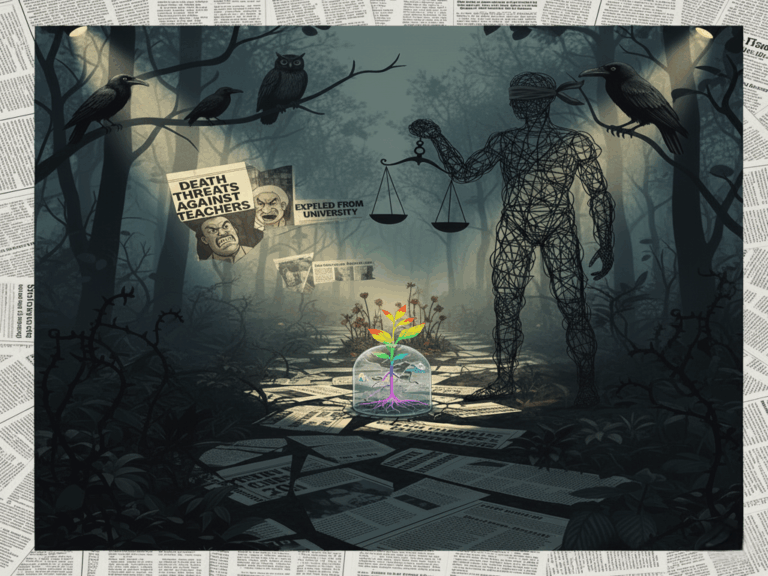
Our analysis shows that Dhaka’s mainstream media largely ignored all three events (the caricature controversy, the university expulsion, and the hunger strike). Although some outlets covered certain parts of the story in a limited way-providing some significant observations-overall, the media response was selective.
The coverage of Bangladeshi news outlets can be divided into three categories:
- Reactions to the caricature and the allegations of incitement to murder.
- Reactions to Sahara’s expulsion from the university.
- Sahara’s hunger strike.
Amar Desh was the only newspaper that directly published a report titled ‘Death threats against two university teachers in the country.’ However, they did not cover Sahara’s expulsion or hunger strike afterwards.
Dhaka Mail, Daily Campus, UNB, Dhaka Post, Kalbela, Daily Janakantha, Jugantor, and the Bangla version of Dhaka Tribune published reports on the reactions to the caricature issue. Yet none of them published any report on Sahara’s expulsion. Only the English version of Dhaka Tribune covered her hunger strike in one article.
On the other hand, regarding Sahara’s expulsion, only Netra News published a Bangla video report titled ‘Sahara: Porichoyhiner Porichoy’ (Identity of the Identity-less). No other outlet reported on this. However, some citizen organizations’ statements protesting the expulsion were covered by Prothom Alo, Ajker Patrika, Bangla Tribune, and the Bangla version of The Business Standard. The English version of The Business Standard published two reports titled,
- Sylhet’s Metropolitan University faces backlash over expulsion of transgender student
- Transgender student’s expulsion from Sylhet university sparks outcry.
In contrast, no Bangla daily covered Sahara’s hunger strike in recent times. Even Prothom Alo, usually regarded as a liberal outlet, ignored the issue. Strikingly, none of the outlets that had reacted to the caricature incident published any report on the hunger strike.
Only two English-language reports have been found on Sahara’s hunger strike:
- Netra News: I was ready to die’: Between despair and defiance, a trans activist takes a stand for LGBTQ rights.
- Dhaka Tribune: Reclaiming the street: The curious case of Sahara Chowdhury and queer citizenship in Bangladesh.
No news outlet reported on her August 22 press conference.
Another notable point is that The Daily Star, known as a liberal leaning newspaper, did not publish any reports on any of the incidents. Likewise, international media outlets like BBC Bangla and Deutsche Welle Bangla remained silent throughout.
Our analysis makes it clear that the media displayed a pattern of selective bias. Those who covered the caricature and incitement issue stayed silent on Sahara’s expulsion, while those who reported on the expulsion avoided the caricature issue. No outlet covered both incidents together.
Finally, the fact that only two English-language reports were published on Sahara’s hunger strike indicates that Bangladesh’s mainstream media is still not sufficiently independent or courageous to take a position on such sensitive and controversial issues.
1 thought on “Silence and Selectivity: How Bangladesh’s Mainstream Media Avoided the Sahara Chowdhury Controversy”
Good article! I had this in mind too. Some interesting information to add.
1) After the press conference, one of Sahara’s friends who arranged it got in minor trouble for hosting it.
2) Of the two English newspapers, the one by Dhaka Tribune was an op-ed by another person whose message did not discuss much of Sahara’s demands for the hunger strike, to this Sahara posted a response through her friends.
3) No one reported on the effigy burning that was done before the strike but after her expulsion.
4) Many lower level infographic pages posted about BD Font Foundry’s “ban” on using the fonts as used by her poster.
5) Initially, during the expulsion, Netra News did a video documentary but not an article. Instead, they also decided to publish an article op-ed by another person. In this case however, discussing the issue of section 377 was relevant with the message at the time. However, if one really cared about the argumentation posed by Sahara and organizers working with her, they have decided to directly demand marriage rights and not follow an incrementalist approach.