
Ayaz Rahman is the Sam Chronicler of Bangladesh Media Monitor.
Bangladesh is an important strategic and commercial arena for Gautam Adani’s business interests, and Prime Minister Tarique Rahman’s visit to Delhi is highly significant for Adani-owned NDTV as India seeks to strengthen commercial and strategic engagement with Dhaka, restore Adani’s business interests in Bangladesh, and reduce China’s growing influence.
The Adani media group’s special interest in Tarique Rahman’s visit to India, along with its strategic framing of the visit, could play a distinct role in putting pressure on Dhaka.
To understand NDTV’s ongoing Dhaka-focused journalism and its strategy of protecting the interests of its owners, it is also important to understand the plans and broader strategic interests of the Gautam Adani business empire. At the same time, what lies behind the importance of the meeting between Tarique Rahman and Narendra Modi for Adani’s media interests?
Sheikh Hasina, who is currently taking shelter in India, may represent either a vulnerability for Delhi or an important instrument of diplomatic strategy. Her press conferences, along with the strategies adopted by sections of the Indian media, provide a significant example of how pressure can be exerted on Dhaka.
Gautam Adani’s Projects Against China
Gautam Adani is playing a major role in port and infrastructure development under the India–Middle East–Europe Economic Corridor (IMEC), a project proposed by India and its Western allies as a strategic and economic alternative to China’s Belt and Road Initiative (BRI).
Instead of China’s Belt and Road Initiative, IMEC is a multinational economic corridor designed to connect India with Europe through the Middle East by sea and rail. The railway connectivity improvements that India is seeking in Bangladesh are also linked to this broader connectivity strategy.
The Adani Group has acquired and operates Israel’s strategically important Haifa Port, which is a key node of the corridor. In India, the Vizhinjam transshipment container port in Kerala is being developed as part of an effort to challenge China’s dominance in international maritime trade.
Adani’s Development Projects Focused on Northeast India
The Adani Group is planning to invest ₹1 trillion in India’s northeastern region over the next 10 years, with major development projects in power, energy, and other sectors.
In Assam, the group is planning major energy projects, including a coal-based ultra-supercritical power plant and pumped-storage hydropower projects.
In addition, the group has plans for an airport city in Guwahati, road and highway expansion projects in Meghalaya and Arunachal Pradesh, and projects involving digital infrastructure.
These projects also have commercial links with Bangladesh, particularly in areas such as electricity and energy security, transit, connectivity, and regional trade corridors.
Tarique–Modi Meeting: NDTV’s Journalism Around Adani’s Projects
Following meetings involving Tarique Rahman and Narendra Modi with Indian diplomats in Dhaka and Delhi, Gautam Adani-owned NDTV published at least two reports focusing on the energy and power crisis. It also published a report on railway connectivity with Bangladesh.
These reports are primarily connected to Gautam Adani’s commercial interests and to the proposed India–Middle East–Europe Economic Corridor (IMEC), which is being positioned as an alternative to China’s Belt and Road Initiative.
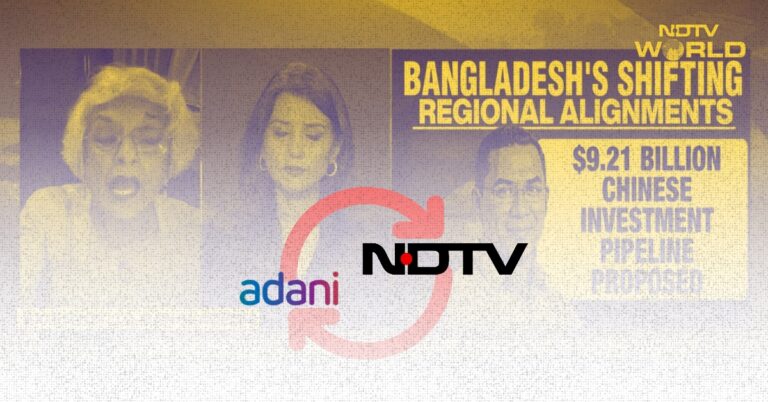
Former Indian Diplomat Veena Sikri on NDTV’s Talk Show
On an NDTV talk show, the presenter gave particular emphasis to commercial issues between Delhi and Dhaka while speaking with former Indian diplomat Veena Sikri. Bangladesh’s energy and electricity shortages were highlighted during the discussion.
The improvement of Dhaka’s diplomatic and economic relations with China and Pakistan was presented as a potential threat to India’s security. In particular, Bangladesh’s discussions with China over the Teesta and Mongla projects came under focus.
These discussions, taken together, primarily serve to protect the commercial interests associated with Gautam Adani’s proposed economic corridor as an alternative to China’s Belt and Road Initiative.