

Ayaz Rahman is the South Asian Media (SAM) Chronicler of the Bangladesh Media Monitor.
An analysis was conducted regarding the nature of news coverage published by Indian media outlets concerning Bangladesh during the first fifteen days of May. The findings indicate that various media organizations have prioritized distinct narratives and agendas in their reporting on the country. Some outlets emphasized border, pushback, and illegal immigration issues; some focused on power plant and business-related matters; while others highlighted religiously provocative topics or published hostile narratives regarding Bangladeshis seeking medical treatment in India. This review is based on an analysis of at least six Indian media outlets.
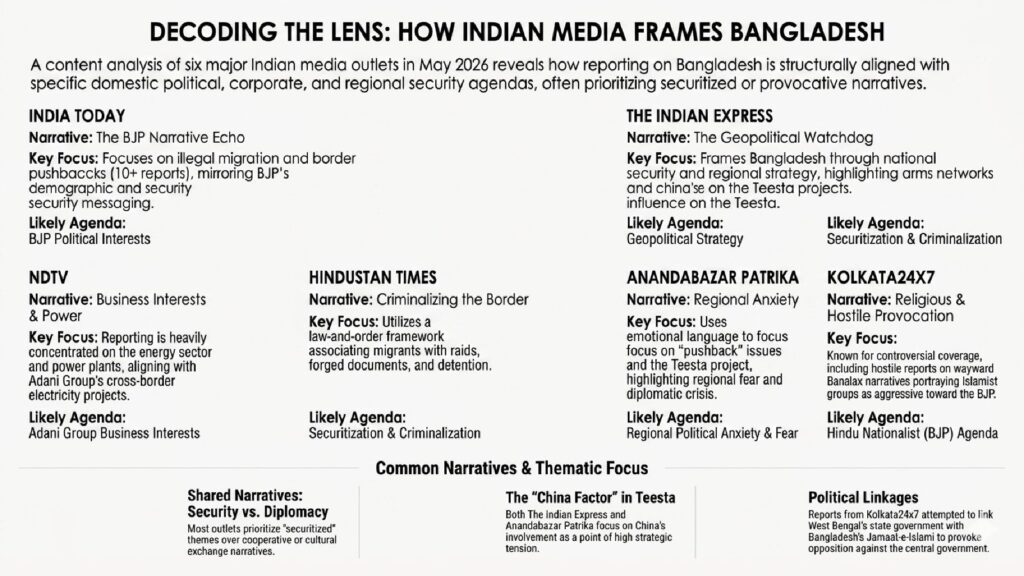
India Today published the highest number of reports on Bangladesh related to border issues, pushbacks, and illegal immigration. Within the first 15 days of the month, the outlet published at least 10 reports solely on these topics. The assessment that the framing of these reports appeared aligned with the political interests of the Bharatiya Janata Party (BJP) is based on a qualitative framing analysis of headline patterns, thematic emphasis, and narrative associations. The coverage repeatedly emphasized issues such as border control, illegal migration, national security, and demographic concerns, themes that have long been central to BJP political messaging, particularly in West Bengal and Assam.
Several headlines directly linked BJP electoral success with stronger border enforcement and Bangladesh’s reaction to it, reinforcing a security-oriented narrative. The reports also frequently used conflict-oriented language such as “illegal migrants,” “pushback,” “border alert,” and references to Islamist groups, contributing to a securitized portrayal of Bangladesh-related issues.
The analysis does not suggest direct coordination or propaganda, but rather that the editorial framing and issue prioritization appeared structurally aligned with themes advantageous to the BJP’s political narrative.
NDTV published at least two reports, one in early May and another in late April, primarily focused on power plant–related issues in its coverage of Bangladesh. This focus appears to correspond with the business interests of Gautam Adani, who is associated with the media outlet, as Bangladesh’s energy sector remains closely linked with Adani Group’s cross-border electricity and power supply projects.
Hindustan Times published two reports on Bangladesh, both centered on the pushback issue. One report frames Bangladeshi migrants as a law-and-order and security issue, using police narratives, raids, detention, and deportation language. It associates migrants with illegal stay, forged documents, and prostitution, creating a criminalized image. Another report frames the issue as a diplomatic dispute between India and Bangladesh. It focuses on “pushback,” nationality verification, and bilateral tensions, while including both Indian and Bangladeshi perspectives and acknowledging possible wrongful identification.
The Indian Express published six reports on Bangladesh during May. Four of them focused on border-related issues. One report covered pushbacks, another discussed China’s involvement in the Teesta mega project, and another claimed links between Bangladeshi illegal arms dealers and Indian extremist groups.
The Indian Express mainly frames Bangladesh through the lenses of security, border control, and geopolitics. Its headlines focus on BSF land transfer, border fencing, illegal migration, arms networks, and law and order, portraying Bangladesh-related issues as security concerns for India. At the same time, reports on Teesta and “push-in” disputes frame Bangladesh within broader diplomatic and India-China strategic tensions.
West Bengal–based Anandabazar Patrika published three reports on Bangladesh during the month so far. Two of them focused on pushback issues, while one discussed the Teesta project involving China. The outlet frames Bangladesh-related issues through fear, tension, and political anxiety. It uses emotional language to portray concerns over BJP-led border policies, possible “push-backs,” and China’s role in the Teesta project, presenting the issue as a sensitive regional and diplomatic crisis.
Another West Bengal–based online outlet, Kolkata24x7, published several controversial and provocative reports regarding Bangladesh. Two reports focused on medical issues, portraying Bangladeshis traveling to India for healthcare in a negative and hostile manner. Four reports emphasized religiously provocative narratives, which appeared to align with the Hindu nationalist political agenda of the BJP in West Bengal. These reports attempted to portray Islamist fundamentalist groups in Bangladesh as highly aggressive toward the BJP.
In addition, one report focused on militancy, while another described NCP politician Sarjis Alam as a “militant.” Two reports attempted to create anti-Pakistan sentiment and tensions by linking Bangladesh with Pakistan. One report framed a gang rape incident specifically as violence against a Hindu woman and claimed Muslims were involved in idol vandalism incidents. Another report alleged that West Bengal Chief Minister Mamata Banerjee was being supported by Bangladesh’s Jamaat-e-Islami in an effort to provoke opposition against the Modi government in Delhi.
Overall, an analysis of Indian media coverage on Bangladesh suggests that a significant portion of these reports directly or indirectly serves the political interests, ideological narratives, or regional political agenda of India’s ruling BJP government.