
Ayaz Ur Rahman: Bangladesh Media Monitor (BMM) reviewed a syndicated report published by NDTV (https://archive.ph/8uWFI), titled “Mob Attacks, Vandalises Hindu Households, Businesses In Bangladesh.” The report was sourced from the Press Trust of India (PTI) feed (https://archive.ph/kmw24). The purpose of this review was to assess how balanced or potentially biased the report is in terms of its framing, language, visual presentation, source selection, and editorial oversight.
The analysis finds that the report tends to portray Bangladesh as an unsafe and communally unstable country. Localised and isolated incidents of violence are placed within a broader narrative of minority persecution, which creates a sense of widespread insecurity. As a result, readers may get the impression that these incidents are not just criminal acts or local disputes, but part of a larger communal crisis.
Another key feature of the report is the way complex social and criminal incidents are interpreted through a communal lens. In the Rangpur case, the victim’s family denied any involvement of the Hindu community. However, the report places greater emphasis on attacks on Hindu homes and businesses. This shifts focus away from the core criminal context of the incident and brings religious identity to the centre of the narrative.
Issues were also identified in the visual presentation. The report uses a file photo from the mass protests of July 2024, which is not directly related to the incident being discussed. Although the image is labelled as a file photo, the mismatch between the image and the reported event may lead readers or viewers to form an exaggerated perception of the scale and nature of the incident. In terms of language, the report includes some emotionally charged and evaluative terms such as “irate mob,” “hacked to death,” and “hard-line Islamists.” While these words do not directly express opinion, they increase the risk of the report being perceived as more intense, sensational, and polarising. In particular, the use of such labels may create a pre-formed negative impression about the groups involved.
Overall, this analysis suggests that while the report is not directly based on false information, it contains elements such as selective framing, partial context, labeling bias, and visual inconsistency. These factors may contribute to portraying Bangladesh as a communally unstable country. Therefore, when evaluating such reports, it is important not only to check whether the information is accurate, but also to consider how the information is structured, which sources are given importance, what context may be missing, and what message the visuals convey.
In this study, Bangladesh Media Monitor followed a qualitative content analysis approach based on framing theory. A specific news report was taken as a case study, and its headline, lead, main body, visual elements and use of sources were examined to understand how a particular narrative is shaped through selection, presentation, and emphasis of information. For data collection, the report itself was used as the primary source, while local media coverage and police statements were used for secondary verification, ensuring triangulation. A structured codebook was applied in the analysis, where emotional framing, labeling bias, source diversity, and visual presentation were assessed to identify the framing patterns and potential bias in the report.
The purpose of this work is to evaluate how a specific narrative is constructed through the combination of framing, language use, visual presentation, and source selection in a news report. In particular, the study aims to objectively examine how potential bias, the presence or absence of context, and the mode of presentation may influence readers’ perception.
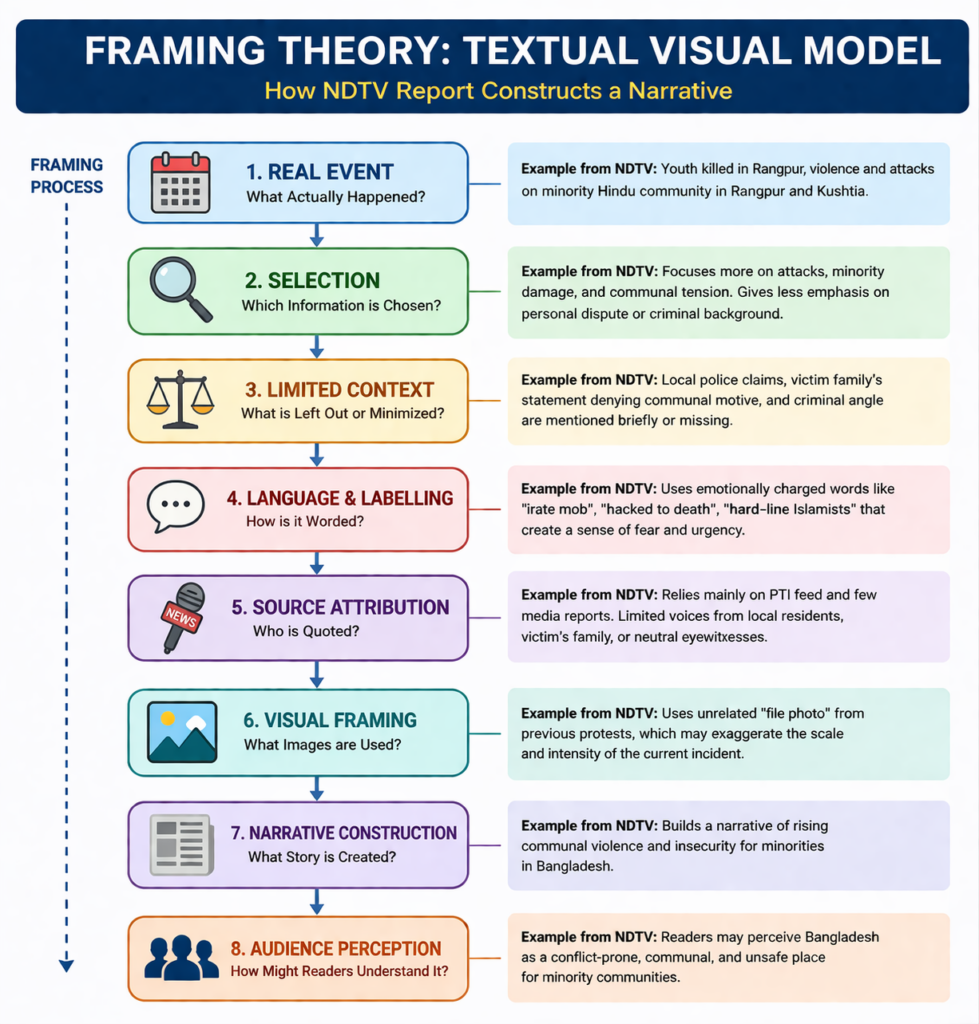
Although the report discusses real incidents of violence in Rangpur and Kushtia, certain aspects are given more emphasis in the way the information is presented, which contributes to shaping a particular narrative. In terms of information selection, the NDTV report places stronger emphasis on the attacks and the losses suffered by minority Hindu communities. However, according to local sources (https://archive.ph/8rlXK), the incidents were linked to personal disputes and criminal motives. This context receives comparatively less attention in the report, which increases the likelihood of the events being interpreted within a broader communal framework.
In terms of contextualisation, the report includes some relevant information, but it remains partial. For example, statements from local police and the victim’s family reported in Bangladeshi media, where communal involvement was denied are either limited or absent in the NDTV report. This reduces the space for alternative explanations and may lead to a more one-sided understanding. In addition, the report uses terms such as “irate mob,” “hacked to death,” and “hard-line Islamists.” While these words do not directly express opinion, they present the events in a more intense, emotional, and conflict-driven manner, which can create fear or heightened reactions among readers. This reflects the activation of emotional framing.
Regarding source attribution, the report relies mainly on PTI. Although one or two local sources are mentioned, overall source diversity remains limited. In particular, there is a lack of detailed statements from the victim’s family or neutral eyewitnesses, which reduces the multidimensional understanding of the incident.
In terms of visual framing, a key concern is the use of an unrelated “file photo.” The image, which is from a previous political protest, is presented alongside the current incident of violence. This creates a risk of exaggerating the scale and intensity of the event in the minds of readers. Taken together, these elements contribute to a specific narrative construction, where Bangladesh is portrayed as a communally tense and unsafe environment for minorities. While the report is not entirely based on false information, the selection of details, language use, limited context and visual presentation indicate a tendency to shape a particular perception.
Emotional Framing Index (EFI)
| Score | Meaning |
| 0 | Neutral language |
| 1 | Moderate emotional tone |
| 2 | Highly emotional / provocative |
Assigned Score: 1 (Moderate Emotional Tone / Moderate Emotional Framing)
In this analysis, the Emotional Framing Index (EFI) is used to assess how much emotion is generated through the language used in the NDTV report. A 0-2 scale is followed, where 0 indicates completely neutral language, 1 indicates a moderate emotional tone and 2 indicates highly emotional or provocative language.
The NDTV report presents the events in a somewhat intense and emotionally engaging way through the use of certain words. However, the language does not reach a fully provocative level. For this reason, it is assessed overall as moderate emotional framing.
To determine this score, several key words and descriptive elements used in the report were examined. First, the phrase “irate mob” creates an image of an angry and uncontrolled crowd. The word “mob” itself carries a negative and emotionally loaded meaning, and the addition of “irate” (angry) further intensifies it. This can make the situation appear more unstable to the reader.
Second, the phrase “hacked to death” creates a strong visual impact. It presents a graphic image of the killing, which may evoke fear, shock, or concern among readers. Such wording often increases emotional response.
Third, the term “vandalised” suggests damage to property, but it also conveys a sense of disorder and aggression. This frames the situation as more conflict-driven.
In addition, the report uses the term “hard-line Islamists,” which labels a specific group in an evaluative way. Such labeling can shape readers’ perceptions in advance and influence how they interpret the events.
However, it is important to note that the report does not use highly exaggerated terms such as “massacre,” “genocide,” or “large-scale ethnic violence.” As a result, the language does not fully reach a highly provocative level.
Labeling & Descriptor Bias (LDB)
| Score | Meaning |
| 0 | Neutral descriptors |
| 1 | Moderately evaluative language |
| 2 | Strong labelling / biased descriptors |
Assigned Score: 2 (Strong Labelling Bias)
The Labelling & Descriptor Bias is used to assess how the words used in a news report may shape a particular perception about individuals or groups. This is evaluated on a 0–2 scale, where 0 indicates fully neutral language, 1 indicates partially evaluative language, and 2 indicates strong labelling.
In the report, certain terms are used that not only provide information but also create a pre-loaded perception. For this reason, the report is assessed as having a high level of, or strong, labelling bias.
First, the term “hard-line Islamists” is a key example of labelling. The word “Islamists” points to a religious-political identity, and the addition of “hard-line” frames it as rigid or extreme. However, the report does not clearly explain the activities or context of this group. As a result, the term functions as an evaluative label, which may influence how readers interpret the situation.
Second, the word “mob” is used, which generally refers to an uncontrolled, emotional, and often violent crowd. While it can be descriptive, it also creates a strong mental image, portraying the individuals involved as part of a chaotic and negative group. The addition of “irate” (angry) further intensifies this perception.
Source Diversity Index (SDI)
| Score | Meaning |
| 0 | Single source |
| 1 | Limited diversity |
| 2 | Multiple balanced sources |
Assigned Score: 1 (Limited Diversity)
The Source Diversity Index is used to assess how many types of sources are used in a report and how balanced they are. A 0-2 scale is followed, where 0 indicates a single source, 1 indicates limited sources, and 2 indicates multiple and well-balanced sources.
In the NDTV report, most of the information is based on PTI and some general “media reports.” Although there is partial inclusion of police or administrative input, the report does not reflect direct and balanced representation from multiple sides. For this reason, a limitation in source use is observed, and it is assessed as limited diversity.
This analysis is based on reviewing how sources are used in the NDTV report. Since the report is a syndicated feed from PTI, it mainly republishes information from a central news agency.
For verification, Bangladesh Media Monitor used a reliable local outlet, Prothom Alo, as a cross-checking source to better understand the ground context and confirm additional details of the incident. Other Indian media outlets were not used in this process in order to avoid repetition within the same information cycle.
Visual Bias Module (VBM)
| Indicator | Score | Meaning |
| Image Selection Bias (ISB) | 2 | Use of images out of context / incorrect image selection |
| Cropping & Visual Emphasis (CVE) | 2 | Misleading visual emphasis and unethical presentation |
| Graphic & Caption Bias (GCB) | 0 | Neutral caption |
| Total Score | 4/6 | ≈ 67% (High Visual Bias) |
In this analysis, the Visual Bias Module is used to reassess the images used in the report and their overall impact. Three indicators, image selection, visual emphasis, and caption are evaluated on a 0-2 scale.
The findings suggest that not only the choice of image, but also the way it is presented (presentation context), creates a strong misleading effect. As a result, the overall score stands at around 67%, indicating a high level of visual bias.
First, for Image Selection Bias (ISB), a score of 2 is assigned. This is because the “file photo” used is not directly related to the actual event. It appears to be from a previous political or mass gathering, which does not accurately represent the current incident of communal violence. This may create a different and exaggerated perception of the situation.
Second, for Cropping & Visual Emphasis (CVE), a score of 2 is also given. The issue here is not only the use of an unrelated image, but also how it is framed. A scene from a political gathering, where many individuals are clearly visible is presented in the context of communal violence. This creates two major concerns. On one hand, it leads to visual misrepresentation, where a political protest is indirectly associated with violent attacks. On the other hand, it raises ethical concerns, as the individuals in the image have no verified connection to the incident, yet are visually linked to it. This type of presentation can be considered misleading visual framing.
Third, for Graphic & Caption Bias (GCB), a score of 0 is assigned. The caption clearly identifies the image as a “file” photo, and the language used remains factual and neutral. However, an important observation is that even when the caption is neutral, the lack of relevance between the image and the event can still create a risk of misinterpretation.
Structural Integrity Score
| (Index) | (Score) |
| Emotional Framing Index (EFI) | 1 |
| Source Diversity Index (SDI) | 1 |
| Labelling & Descriptor Bias (LDB) | 2 |
| Image Selection Bias (ISB) | 2 |
| Cropping & Visual Emphasis (CVE) | 2 |
| Graphic & Caption Bias (GCB) | 0 |
| Framing Bias | 2 |
| Total | 10 / 14 |
SIS = (10 ÷ 14) × 100 = 71%
Upper-Medium Structural Bias
In this section, the Structural Integrity Score is used to evaluate how balanced or biased the overall structure of the report is. Different indices such as language, sources, visuals, and framing are combined to produce a single overall score.
The analysis shows that the report scores 10 out of 14, which is approximately 71%. This suggests that while some of the factual elements in the report are accurate, the overall presentation structure places greater emphasis on certain aspects over others.
Narrative Pattern Analysis
| Pattern | Presentation | Potential Effect |
| Communal Escalation Framing | Emphasising violence as communal in nature | May make the level of conflict appear higher |
| Minority Insecurity Narrative | Highlighting risks faced by minority groups | Creates a perception of insecurity |
| Context Omission | Partial or missing alternative context | Leads to a one-sided interpretation |
Overall Pattern: Patterned Selective Amplification
In this section, Narrative Pattern Analysis is used to identify recurring patterns in how the NDTV report presents information. Although the analysis is based on a single report, it examines which types of framing are repeatedly emphasised within it.
First, a pattern of communal escalation framing can be observed. The incidents of violence are presented in a way that may position them as part of a broader communal tension. For example, repeated emphasis on attacks on Hindu homes and businesses tends to steer the narrative toward a religion-based conflict.
Second, a minority insecurity narrative is constructed. The report highlights damage and attacks targeting the Hindu minority community, and also refers to “133 incidents of communal violence” in the past. This creates a sense of ongoing insecurity and may lead readers to perceive Bangladesh as a risky environment for minorities.
Third, context omission or limited contextualisation is evident. While other sources indicate that the incidents may be linked to criminal motives or personal disputes, this aspect receives comparatively less attention in the NDTV report. Similarly, alternative explanations from the victim’s family are only minimally included. As a result, the report presents a partial rather than a fully comprehensive picture.
In this research, Bangladesh Media Monitor follows a clear ethical positioning, without adopting any political alignment. The analysis maintains analytical neutrality, ensuring that it does not take a position in favour of or against any country, group, or media outlet. The primary focus is on examining information, language, visuals, and presentation structure, rather than promoting any viewpoint.
Each observation in this process is based on evidence-based interpretation. Language, labelling, sources, and visual elements are analysed with specific examples. In addition, cross-checking sources are used to verify information, ensuring triangulation and strengthening the reliability of the analysis.
It is also important to note that limited AI assistance was used in this research for organising initial data, linguistic analysis, and structuring. However, all outputs were carefully reviewed and verified by human researchers at each stage, with necessary revisions and contextual checks. This ensures that the final analysis reflects human judgement, contextual understanding, and established research standards.